Sunday, July 13, 2008

Wolfgang Weileder: "Fold-up" Sunderland, UK


Wolfgang Weileder

Fold-up

a full-scale site-specific architectural installation
Sunniside Gardens, Sunderland UK,
June and July 2008

http://www.fold-up.info/

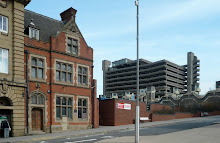
The latest in a series of architectural structures by artist Wolfgang Weileder, fold-up is a full-scale replica of 15 Norfolk Street which fronts onto the gardens. Reminiscent of an unfinished cut-out paper model, the artwork reveals the process, labour and skill of building as a visible experience. Fold-up offers a new perspective on the familiar and overlooked structures within the city, and creates a dialogue between the historic heart of Sunniside and the modern developments that are transforming this area of the city.

The project is being constructed and sponsored by Sunderland-based company r.Bau Ltd. Specialising in continental building technologies, their collaborations with Wolfgang Weileder have been an opportunity for r.Bau Ltd to demonstrate their workmanship throughout Europe. Company director Paul Webster and his team are particularly proud to be creating their most complex project to date for their home town. The speed with which fold-up will be built is achieved with dry-joint blocks which slot together without traditional mortar. For this project r.Bau Ltd will be joined by apprentices from Newcastle College, who are providing much of the joinery and roofing products and additional labour. Fold-up is a unique opportunity to learn a new technique and a high-profile showcase for their skills.

The project has been developed and supported by Sunderland City Council’s Arts Team and forms part of a major programme of temporary and permanent public art commissions throughout the city. When complete, the artwork will be open to the public for a sixteen day period, before being dismantled by r.Bau Ltd and the materials supplied to the construction college or recycled.

A documentary film and still photography will record the build process and the completed project, and these images will tour internationally to galleries and festivals. A publication of the project is also planned

Sunday, July 06, 2008

Marcus Coates: "Machinic Alliances" Danielle Arnaud contemporary art, London, UK


Machinic Alliances

Rieko Akatsuka, Liz Arnold, Edwina Ashton, Marcus Coates, David Cotterrell, Lucy Gunning, Jaki Irvine,
Paulette Phillips, Kate Smith, Mo Throp, & Clara Ursitti

curated by Maria Walsh, Mo Throp and Danielle Arnaud

4 July - 10 August 2008


Machinic Alliances

Rieko Akatsuka, Liz Arnold, Edwina Ashton, Marcus Coates, David Cotterrell, Lucy Gunning, Jaki Irvine,
Paulette Phillips, Kate Smith, Mo Throp, & Clara Ursitti

curated by Maria Walsh, Mo Throp and Danielle Arnaud

4 July - 10 August 2008

The 'machinic' is a process that expresses our capacity as humans to form alliances with non-human forces, be they animal, insect, plant or virus. The exhibition 'Machinic Alliances' takes this Deleuzian premise as the basis from which to propose unholy affiliations between categories of human/animal/technological.
The artworks in this exhibition seek to question, challenge, and flirt with traditional concepts of Western subjectivity. Thrown to the wind is the plot of an original wholeness and purity. Instead, 'machinic alliances' scramble and graft singular identities, creating perverse formations that escape the Oedipal trap of filiation (Donna Haraway 2004). These formations or assemblages have no father, like Frankenstein, and eschew anthropocentric identification. In their multiplicity, they push against the limits of form.
Categories are undone.
Awkward conjoinings arise.
Inhuman differences emerge.
But paradoxically, it is here in the interstitial spaces proposed by 'machinic alliances' that we can learn how to live differently. In these spaces, we can experience the 'mutual interdependences and productive mergers of forces' that characterise subjectivity at the end of the postmodern (Rosi Braidotti, 2006). The ‘new’ alliances explored by the artworks in this exhibition do not reproduce the antagonism of one self against another self, but generate a bestiary of possible selves, liberating us from the alienating problematics of narcissistic recognition and opening us up to the creative becomings of being. The artworks in this exhibition propel us to imagine wacky and wonderful possibilities for our identities. Disturbing, yet pleasurable, these 'machinations' acknowledge the difficulty of difference, yet relish in the production of anomalous differences that exceed categorization.

A catalogue will be published with writings by Rosi Braidotti and Maria Walsh

Danielle Arnaud contemporary art
123 Kennington Road London SE11 6SF
www.daniellearnaud.com

Image:
Marcus Coates
Red Fox (Self Portrait)
1999
Archival Inkjet Print

Ginny Reed & Richard Rigg: "draw a line, follow it" Allenheads Contemporary Arts, UK

"draw a line, follow it"

Friday 4th – Sunday 27th July
Weekends 10am – 5pm
Monday to Friday by arrangement

Exhibiting Artists:
Alex Charrington, Rachael Clewlow, Nick Kennedy, Tuesday Nesbitt, Ginny Reed, Richard Rigg, Anne Vibeke Mou

ACA, Allenheads Contemporary Arts, Old School House, Allenheads, Northumberland, NE47 9HR

www.acart.org.uk

Monday, June 30, 2008

Francis Gomila: "LAST TRAIN" Arts Council England North East, UK


Francis Gomila's Last Train will be exhibited at Arts Council England North East for the month of July.

In LAST TRAIN (filmed in no-man's-land territory between the Slovak/Austrian borders,) Francis Gomila presents a journey located between a deeper landscape of boundary-less
senses of the mind; a sculptural journey between the real and the imagined. We witness time captured and stretched in distilled detail. Time passing is held, pulled back,
information reversed, penetrated and shifting like a visual analogy of theoretical physics en route. Hannah Finlator.

further info contact:
www.artscouncil.org.uk

image:
Francis Gomila
LAST TRAIN 2005. DVD 5’:40.

Tuesday, June 03, 2008

Cecilia Stenbom: "VIEW08 Finnish Media Art Festival" Helsinki, Finland


VIEW08 Finnish Media Art Festival
Andorra, Helsinki

24.5.2008 - 25.5.2008

Artists included: Aho Björn, Antikainen Pia, Anttila Hanna Maria, Arlander Annette, Astala Lauri, Brander Pirjetta, Granö Veli, Ekström Saara, Haikala Eeva-Mari, Hukkataiva Helinä, Ivars Hanne, Kangasmaa Tuomo, Kasitonni Anssi, Koistila Tanja, Koivumäki Juhani, Kokko Jaana, Lampisuo Marko, Lassila Nina, Lecklin Johanna, Luhta Lauri, Maasalo Mikko, Mäki Teemu, Mäki-Jussila Juha, Näsänen Elena, Niemi-Junkola Fanni, Nygren Anneli, Oja Marjatta & Keränen Asko, Palosaari Sari, Pennanen Anu, Pink Twins, Puhakka Vesa, Puranen Saila, Reinhard Aurora, Renvall Markus, Renvall Seppo, Romo Heidi, Rouhiainen Simo, Rousseau Gregoire, Ruscica Jani, Saloranta Elina, Salosmaa Aarno, Savolainen Alli, Seraphin Lena, Stenbom Cecilia, Takala Pilvi, Timonen Maija, Tykkä Salla, Viita Milja, Virkajärvi Sampsa, Whitehead Oliver, Yli-Annala Kari, Ziegler Denize

Image:

Cecilia Stenbom
The Inspector, 2007
HD Video (Widescreen)
Duration 4'16"

Sunday, June 01, 2008

Peter J. Evans: "Prospects and Interiors: Recent acquisitions of sculptors’ drawings" Henry Moore Institute, Leeds, UK


01.06.08 - 24.08.08
Exhibition
Mezzanine Gallery
Henry Moore Institute, Leeds

Taking as its point of departure Liadin Cooke’s compelling representation of the ‘Red Room’ in which Jane Eyre was locked up overnight by her unfeeling aunt, Prospects and Interiors looks at drawings by contemporary sculptors of interior space, both physical and mental. The selection ranges from perspective drawings of imagined architectural interiors, laid out as virtual stage sets with a series of suggestive props; through highly worked, close-up studies, in which floors, walls and furnishings are turned into abstract patterns; to more expressive abstractions which describe the interior spaces of the mind, those places onto which we project our hopes and fears.

Running throughout the show is the sculptor’s concern to find a way of representing space as matter. It explores the peculiar ability of the drawn line or mark to make evident usually invisible currents and forces - such as heat, sound and emotion - and to dissolve material differences between various objects and between objects and space. It suggests that, through drawing, sculptors can express space in new ways - in terms of light and shade, emotional and physical forces and particles of matter - and make ‘nothingness’ into something that is ‘full’ and charged with energy.

Prospects and Interiors is based around a core of works in the Leeds collection, including several new acquisitions, with the addition of a number of loans. It includes work by Ed Allington, Phyllida Barlow, Anna Barriball, Nathan Coley, Liadin Cooke, Tony Cragg, Peter J. Evans, Magdalena Jetelova, Minjung Kim, Rosie Leventon, John Newling, Rick Oginz, Carl Plackman, Martin Westwood, Rachel Whiteread, Stephen Willats and Bill Woodrow.

The exhibition will be accompanied by an essay written by the curator Sophie Raikes.

image:
Peter J. Evans
The Universe & You #4, 2004
Graphite on Paper
64 x 88 x 5 cms, 25.22 x 34.67 x 1.97 inches

Friday, May 16, 2008

Matt Stokes: "Manic Organic" Brighton Festival, Brighton, UK


Brighton Festival - Manic Organic - Thursday 15th May 2008
The Necks, Robert Lippok, Matt Stokes Sacred Selections, performed and transcribed by Paul Ayres and William Whitehead. £10, £15.

Exclusive to Brighton Festival

In its heyday Brighton Dome's hand-built 1936 pipe organ was the centrepiece of the world's longest running seaside concert series. Seventy years on Brighton Festival puts a subversive new spin on the 'organ extravaganza' in a 21st century renegade recital.

First to put its 3,000 pipes through their paces (with Italian harpist Beatrice Martini) is Robert Lippok, a seminal figure on Berlin's ambient electronica scene and founder of German post-rock outfit To Rococo Rot. In hot pursuit are Australia's The Necks, arguably the most exploratory and riveting avant-improv trio on the planet, tonight trading piano for pipe organ for their freeform sonic adventures.

Mixing up the medicine throughout in a series of mind-bending organ excursions is Sacred Selections, a brave music venture curated by Beck's Futures prize-winner Matt Stokes. Here, the high-octane break beats of rave-era Happy Hardcore and publicly selected tracks from Brighton's recent musical output are transcribed and performed live by renowned concert organists Paul Ayres and William Whitehead.

Pull out all the stops - its time to get Manic Organic!

Marcus Coates: "The HAMSTERWHEEL" MALMO KONSTHALL, Sweden


The Hamsterwheel
17 May – 17 August 2008
Malmö Konsthall, S:t Johannesgatan 7, SE-200 10 Malmö, Sweden

John Bock, Jean-Marc Bustamante, Marcus Coates, Urs Fischer, Peter Fischli/David Weiss, Olivier Garbay, Gelitin, Douglas Gordon, Rachel Harrison, Georg Herold, Christian Jankowski, Mark Leckey, Erik van Lieshout, Sarah Lucas, Jonathan Monk, Maurizio Nannucci, Paola Pivi, Rudolf Polanszky, Anselm Reyle, José Ruiz Gonzalez, Tamuna Sirbiladze, Annika Ström, Una Szeemann, Piotr Uklanski, Hans Weigand, Franz West, Toby Ziegler, Ralf Ziervogel, David Zink Yi, Thomas Zipp.

The Hamsterwheel is an exhibition initiated by the Austrian artist Franz West, and was originally presented at La Biennale di Venezia, 2007. The exhibition includes paintings, sculptures, installations, films, text works etcetera by some thirty artists. The video works are selected in collaboration with Veit Loers. The exhibition has since then travelled to the Festival de Printemps de Septembre, Toulouse, and Centre d’Art Santa Monica, Barcelona. At each exhibition venue the presentation of the works and relation to each other changes dramatically.

Marcus Coates
Radio Shaman, 2006
HD Video Installation
09:31 mins
Courtesy of the Artist and Workplace Gallery

Catherine Bertola: "The Enchanted Moment" BALTIC Centre For Contemporary Art, Gateshead, UK


THE ENCHANTED MOMENT
17 May - 25 May 2008
Catherine Betola, Karen Davies & Natalie Frost

BALTIC Centre for Contemporary Art Gateshead Quays South Shore Road Gateshead NE8 3BA UK

The Enchanted Moment is a cluster of contemporary art exhibitions organised by VAF – Visual Arts Forum, North East. Three artists from the North East - Karen Davies, Natalie Frost and Catherine Bertola have transformed the level 5 viewing box with site-specific work.

Natalie Frost’s series of candy-coloured posters reveal the experiences of new mothers whose ‘enchanted moment’ was not the positive one commonly promoted. Catherine Bertola’s delicate designs will creep across the floor of Level 5 and are enlarged details of patterns from mass manufactured lace and templates used in hand making bobbin lace, contrasting the traditional and contemporary aspects of this fabric. Karen Davies has created a series of new drawings of British birds to introduce the idea of height and flight to the majestic Level 5 viewing box, and bring an element of nature to the architectural space of BALTIC.

Ginny Reed: "The Late Shows" Hatton Gallery, Newcastle, UK


The Late Shows
Saturday 17th May 7pm – 11pm
Hatton Gallery
Newcastle University
Exhibition continues until May 22nd

Through the looking glass and over the rainbow

Go home to drawing, to the breath, to the magic of thought spiralling out of a pencil or a pen. Only rarely do we stop to imagine the potential in a pencil or a jar of ink. Artists can draw in other materials in addition to ink, but what is consistent is that limited means always produces something beyond the materials. Always the potential multiplies.
Ginny Reed’s work is very generous to the viewer because it gives us an intensification of a moment in time. It is almost always most joyful. I once described her work to someone as consisting of the blessing of a moment. Her work is particularly ambitious in the context of the enchanted moment because she is taking the above text as fuel for the work.

www.thelateshows.org.uk

Tuesday, May 06, 2008

Marcus Coates & Laura Lancaster: "Micro-Narratives" Musée d'Art Moderne de Saint Etienne, France


Micro-narratives : tentation des petites réalités, Musée d'Art Moderne de Saint Etienne
07 May 2008 - 21 September 2008

Curated by Lóránd Hegyi

The exhibition 'MICRO-NARRATIVES' represents 85 positions by contemporary artists whose activity manifests an occupation with an anthropological orientation and tries to find the new narrative in the micro-communities, in the personal experiences, in the intimate and personal inmediate contexts, which resist again the monumental, hierarhic, universalistical explications of society and culture.

List of Artists: Alberola, Andjelic-Galic, Armleder, Arnautovic, Badiola, Bajic, Barabash, Berruti, Binder, Boggasch, Bosnic, Bussmann, Cabrita Reis, Calic, Cano, Cantoni, Cernicky, Chun, Civera, Coates, Cornet, Den Uyl, Djuric, Dzafo, Eichhorn, Feriancova, Friedl, Friedmann, Gontarski, Grassino, Gray, Han, Hapaska, Holcova, Horakova, Irazu, Joatton, Kimsooja, Kim, Kovacheva, Lancaster, Langlade, Lehocka, Leikauf, Levini, Löhr, Mattii, McCaslin, Mezzaqui, Milicevic, Mizrachi, Moizer, Nemeth, Nolan, Noh, Palla, Paris, Perez Simao, Pétrovitch, Petrovic, Poljak, Popovic, Prego, Prodanovic, Rajkovic, Revesz, Rubiku, Savini, Seric Shoba, Stefanoff, Stojanovic, Szepfalvi, Toguo, Vasquez de la Horra, Vedovamazzei, Vidor, Vincourova, Weinberger, Skart, XYZ, Yee, Yoo, Zupanc

http://www.mam-st-etienne.fr/
http://micronarratives.wordpress.com/

Marcus Coates
Radio Shaman, 2006
HD Video Installation
Courtesy of the artist and Workplace Gallery

Laura Lancaster
Untitled, 2005 (detail)
Watercolour, Gouache and Graphite on Paper
Courtesy of the artist and Workplace Gallery

Tuesday, April 29, 2008

Jo Coupe: "Tatton Park Biennial 2008" UK


Image: Jo Coupe 'Rarefied (Phalaenopsis lobii)', 18ct rose, 15 x 10cm

Tatton Park Biennial 3 May - 28 September 2008

Tatton Park Biennial is a new contemporary art event for the UK supported by The Northwest Regional Development Agency; Arts Council England, Northwest; Cheshire County Council; Cheshire's Year of Gardens 08; The National Trust; Manchester Airport; The Tatton Park Trust and Tatton Park. The Biennial will be staged from May to September 2008 and presented in association with Cheshire’s Year of Gardens 08.

Curated by Danielle Arnaud and Jordan Kaplan from commissioning group Parabola, the 2008 Biennial theme is Botanical Collections and Collectors. Over 30 artists, performers and writers will develop new work in response to Tatton Park's gardens, investigating the legacy of collections, collectors and the designed landscape amid current issues of climate change and globalisation.

Jo Coupe’s work for the Biennial focuses on the value and collectability of objects; their value as things bought and sold, traded, catalogued and displayed. She has worked with Tatton’s Orchid collection, which, like any botanic assemblage is prone to decay. It is also of extreme monetary worth, with some specimens fetching thousands of pounds when made available for sale. It is this sense of the ‘worth’ and ‘value’ of Tatton’s collections that has caught the artist’s imagination and has spurred her on to produce a solid gold cast of a rare orchid. Its placement, in the Orchid House, is deliberately problematic – how can the work of art be viewed when the glasshouse that contains it is not opened to the public most of the time? How can these specimens afforded titles of exceptionality be anything but rarefied?
Corruptibility is part and parcel of a valuable collection: it suggests both issues of decay and, more pertinent to this work, perhaps, issues of conscience. The Orchid House is normally only open to the public when staffed because of the precocity and delicate nature of its contents and the need to interpret these unusual plants. Coupe’s cast challenges this perception, tossed to one side in the gravel alongside its living relatives, it invites theft, but, as it is contained within a ‘safe’ environment (literally and figuratively – the living orchid has been cut, killed and preserved as a gold-encrusted corpse), little harm can come to it.
Part of the joy of the work is the knowledge that many of the plants that sit near to it are much more ‘valuable’ than the object itself. The artist asks which one is most precious? When all known signifiers of status are removed, can we see the inherent value the connoisseur dedicates a lifetime to perfecting their understanding of?

contact Tatton Park
Tatton Park, Knutsford,
Cheshire, WA16 6QN
Tel +44 (0) 1625 374400
info@tattonparkbiennial.org

Sunday, April 20, 2008

Matt Stokes: "I desired what you were, I need what you are" MAZE Gallery, Turin, Italy


I desired what you were, I need what you are
Curated by Ilaria Gianni

April 23 – June 15, 2008
Turin , Maze Gallery
Opening: Wednesday April 23 April, from 6 pm

Marcelline Delbecq, Patrizio Di Massimo, Iain Forsyth & Jane Pollard, Cyprien Galliard, Ryan Gander, Mario Garcia Torres, Olivia Plender, Jamie Shovlin, Matt Stokes

I desired what you were, I need what you are, is a group show that reflects upon the re-elaboration and interpretation of residual cultural elements and symbols that have remained in front line as issues or as myths in dominant cultural practices such as cinema, art and music and which have been used, interpreted and desired by a generation that has lived a lack of ideologies, but which has had the scent of them through a second hand experience.

I desired what you were, I need what you are, aims to concretize the discourse that many times has been superficially approached, concerning how the generation born between the 1970s and 1980s has grown up deprived of the possibility of believing in a present certainty, disillusioned after having experienced the social, political and cultural failures of the time they lived. Their attempt of revolutionary élan has been suffocated by the massive productivism of an era in which everything is englobed by the dominant systems and transformed in industrial mechanisms. I desired what you were, I need what you are focuses on the 'attitudes' of a time that gives no possibility of utopian thinking, no space to be heroic.

I desired what you were, I need what you are reflects upon the loss and lack of absolute ideals in the present age, through the use of past cultural products and ideologies, adopted, appropriated and inherited by generations. It is the gap between what 'has been' and 'what is', that I desired what you were, I need what you are positions itself.

It is not the myth of art, cinema and music in their essence that the show aims to explore but a particular legend that has been legitimized by its presence in these macro cultural products that create our system, and that has resisted through time, taking the form of the 'residual'. This last concept is intended as sociologist Raymond Williams explains: as something that "has been effectively formed in the past, but is still active in the cultural process, not only and often not at all, as an element of the past, but as an effective element of the present". The notion of myth seems to explain what the residual has become.

Patrizio Di Massimo, Cyprien Galliard, Mario Garcia Torres, rethink artistic practices, especially those from the 1960s and 1970s, considered, by many artists, the last cultural art movement that brought idea, criticality, provocation, experimentation and courage in front line, a period seen as mythical, whose figures have become sacred monsters. Residual elements are also evident in the music system, surviving as living legends. Bands, movements and events from the past become spaces in which memory gathers and emotions conceal. Certain events, figures and experimentations, so far away but still so close, continue to play a key role in society as underlined by Iain Forsyth & Jane Pollard, Jamie Shovlin and Matt Stokes. The element of illusion created by the overlapping of fact and fiction, which constitutes cinema's essence and haunts our approach towards its reading, has also been analysed in its stratifications through time. The tangible and profound myth of cinema isn't in its figures or in its films but primarily in its revolutionary capacity of 'illusion'. The works by Marcelline Delbecq, Ryan Gander, Jamie Shovlin, Olivia Plender are looking at this substantial moment.

I desired what you were, I need what you are, shows how art is attempting to produce a device that serves secret desires: a way of making mythologies, issues and legends come true, an attempt to get closer to the desire for the authentic. The show positions itself precisely where the revolution of our time seems to lay: fulfilling a dream of authenticity where the 'residual' becomes 'emergent'.

A catalogue in limited edition, expanding on the ideas raised in I desired what you were, I need what you are, edited by Ilaria Gianni with contributions by Stephanie Bertrand, Cecilia Canziani, Isobel Harbison, Luca Lo Pinto, Filipa Ramos, Francesco Pedraglio, Cally Spooner, Caterina Riva and Ilaria Gianni, will be presented the day of the opening.
I desired what you were, I need what you are, is a project elaborated in the framework of Goldsmiths College University of London , MFA Curating, 2006-2007.

The show is opened until June 15; Tuesday to Saturday, from 3.30 pm to 7.30 pm, except for holidays

Tuesday, April 15, 2008

Eric Bainbridge: "OPEN SPACE" Art Cologne 2008


Eric Bainbridge
Das Rheingold (No. 2), 2008
Melamine, Glasses
122 x 120 x 20 cms
(EB0058)
Courtesy of the artist and Workplace Gallery

OPEN SPACE 2008 IS THE 4TH APPROACH TO A PROJECTORIENTED, SPACIOUS OVERALL ART PRESENTATION, INVOLVING MORE THAN
40 INTERNATIONAL GALLERIES WITH CONTEMPORARY ART PROJECTS
AND SOLO SHOWS AT THE 42ND ART COLOGNE (16–20 APRIL 2008).

PARTICIPANTS international galleries with a current program of contemporary art are invited to present a singular artistic position and/or work of art. Participants will be expressly invited and selected by the independent committee for OPEN SPACE. All participants and presentations will be part of an unique, spacious setting to overcome common booth separations towards a joint experience.

COMMITTEE Tobias Berger (Hong Kong), Jörn Bötnagel (Köln), Sorcha Dallas (Glasgow), Daniel Hug (Los Angeles), Stefan Kalmár (München), Beatrix Ruf (Zürich), Gabriele Senn (Wien)

OPEN SPACE 2008 galleries A–Z
Adamski, Aachen / Berlin • BQ, Cologne • Lena Brüning, Berlin • Sandra Bürgel, Berlin • Charim Galerie, Vienna • Galerie Crone, Berlin • croy nielsen, Berlin • Figge von Rosen, Cologne • Carl Freedman Gallery, London • Vera Gliem, Cologne • Hammelehle und Ahrens, Cologne • The Happy Lion, Los Angeles • Hauser & Wirth, Zurich • Kai Hölzner, Berlin • Hohenlohe, Vienna • Daniel Hug, Los Angeles • Johnen + Schöttle, Cologne • Iris Kadel, Karlsruhe • Galerie Kamm, Berlin • Ben Kaufmann, Berlin • Anton Kern, New York • Dennis Kimmerich, Dusseldorf • Johann König, Berlin • Kontainer Gallery, Los Angeles • David Kordansky, Los Angeles • Krobath Wimmer, Vienna • Layr Wüstenhagen, Vienna • Stella Lohaus, Antwerp • Linn Lühn, Cologne • Madonna Fust Galerie, Bern • Mirko Mayer, Cologne • Mezzanin, Vienna • Francesca Minini, Milano • Mot International Ltd., London • Christian Nagel, Cologne / Berlin • Neue Alte Brücke, Frankfurt • Nosbaum & Reding, Luxembourg • Maureen Paley, London • Thomas Rehbein, Cologne • Rental Gallery, New York shows: Andrew Kreps, New York / Sister Gallery, Los Angeles / Ritter Zamet, London • Jette Rudolph, Berlin • Schmidt & Maczollek, Cologne • Schnittraum / Lutz Becker, Cologne • Gabriele Senn, Vienna • September, Berlin • Solway Jones, Los Angeles • Vartai, Vilnius • Michael Wiesehöfer, Cologne • Eva Winkeler, Frankfurt • Workplace Gallery, Gateshead

Thursday, April 03, 2008

Rachel Lancaster & Laura Lancaster: "Harker Herald" Newcastle upon Tyne, UK


Untitled
2008
Rachel and Laura Lancaster

Billboard Commission during APRIL 2008

Waygood Gallery & Studios
548-560 Shields Road, Byker,
Newcastle upon Tyne NE6 2UT


This image is a still from a found cine film, and is the first collaborative work by Rachel and Laura Lancaster.

Both artists are primarily painters but have used this project to explore their mutual interest in re-contextualisation of found imagery and the selection/editing processes involved in their practice.

“Through the selection process and the increase in scale to billboard size, this potentially overlooked mundane image becomes painterly and mysterious and highlights a crossover of Rachel's interest in the tension created by ambiguity, and Laura's interest in the re-use of strangers discarded memories.”

Rachel and Laura Lancaster

Tuesday, April 01, 2008

Marcus Coates, Jo Coupe, and Laura Lancaster: "101 Tokyo Art Fair", Tokyo, Japan


For 101 Tokyo Workplace Gallery presents works by Marcus Coates, Jo Coupe, and Laura Lancaster that examine themes of spirituality, death, and nostalgia.

Marcus Coates HD Video 'Kamikuchi' (‘mouth of god’) 2006 was staged in Ikebukero a district of Tokyo as part of a larger festival produced by Ikebukero Arts Festival in 2006. Coates working both as shaman and artist invited the festival organisers to come up with a question that was important for this district of Tokyo (the question came from a meeting between the festival organisers and the regional city council) The question, put ‘live’ to Coates without prior knowledge, is "What can we do about illegal cycle parking?". Dressed as Marilyn Monroe in kitten heels and a necklace of money Coates takes his question through a shamanic ritual (backed by bird song and Drum & Bass!) where he communicates with animal spirits who he hopes will provide an interpretation.

Jo Coupe examines degenerative transformations and the fantastical, often using pseudo-scientific experiments and materials to investigate mystery and rationalism.
Heavily influenced by still life painting, transformation and mortality epitomized in 'Enough Rope' a sculptural piece which developed from an exploration into the processes of decay. A pile of decaying fruit, studded with electrodes, is generating its own electricity. This arrangement is placed on an ornate round table. The still life is wired to a clutch of buzzing cutting devices that over time, cut into the leg of the table supporting the fruit.

Embedded firmly within a tradition of figurative painting and portraiture Laura Lancaster’s subject matter is gleaned from abandoned memories to form an archive of the intimate and the banal. Through the act of painting and drawing Lancaster elevates those commonplace and overlooked moments of humanity that come to pass. Though intimate, sentimentalism is circumvented by the distancing effect of the mechanised formality of her process. The selected photograph is copied in one sitting in oil or acrylic to canvas or board of appropriate size, then catalogued and dated by day, month, and year, and indexed numerically within that day. All works are Untitled. Her choice of images can be unnerving: a wedding photo with the groom’s face cropped off by amateur camera work, under exposed interiors, a blurred Donald Duck, a faded formal group photograph, or the thousand yard stare of the young and the elderly. En masse Lancaster’s works form ambiguous and dislocated narratives of loss and melancholy. All becomes generic under Lancaster’s touch, her figures maintaining a slippery anonymity owing as much to the tactics of minimalism as to traditional technique.

http://www.101tokyo.com/en/

Thursday, March 27, 2008

Darren Banks: "EPIC" Autoitalia, London, UK


AUTO-ITALIA is proud to present EPIC

Zayne Armstrong
Jennifer Bailey
Darren Banks
Mark Barker
Zoe Barker
Tristram Bellotti
Robert Bidder
Graham Bond
Suyra Buck
Ildiko Buckley
Helen Cocker
Laurence Collyer
Theo Cook
Mark Coutts-Smith
Juila Crabtree
Danielle Dean
William Evans
Francis Frederick
Jon Garlick
Jack George
Joseph Gibson
Katie Guggenheim
Eugenia Ivanissevich
Justin Jaeckle
Richard John Jones
Kiran Kaur
Robert Kiff
Simon Leahy
James Lewis
Mirah Lucas
Louisa Martin
Jamie Moakes
Fay Nicolson
Daniel Oliver
Molly Palmer
Siôn Parkinson
Nick Roberts
Ryder and Prothero
Nick Smith
Maggie Tran
Scott Travis
Jen Walke
Graeme Walker
Dan White
Alistair Wildblood
Sarah Yates

430 - 432 Old Kent Road, entrance on Glengall Road, SE1 5AG
27th March - 6 April 2008
Private view Wednesday 26th March, 6 - 9pm
Open Thursday to Sunday 12 till 6pm
www.autoitaliasoutheast.org

Auto - italia opened in Peckham in March 2007 and after seven exhibitions over the past year we have relocated to the Old Kent Road. This enormous new space has fostered dreams of projects that are monumental in both scale and significance. In Epic we want to acknowledge this sense over-ambition, but also express the importance of the project to us.

For the inaugural show at the new space the artists invited to participate have all contributed in some way to the previous incarnation of auto-italia south east, or to the development of the next stage in the life of the gallery. Creating an environment where artists can work with their peers in the exhibition and discussion of each other's work is central to the role of the gallery. This show is an opportunity to explore the evolution of the gallery and the group of artists involved, and to expand this group by introducing the space to a wider audience.

Thursday, March 20, 2008

Eric Bainbridge: "Anxious Object" STORE, London


Anxious Object

Eric Bainbridge, Carl Plackman, Pamela Rosenkranz

21 March – 3 May 2008

PV Thursday 20 March 2008


“Some people appear to move and act as if they were completely at ease in the world. I have always felt ill at ease; my body fitting as awkwardly as my clothes, the spaces in which I move just that little too empty or full, the air too hot or cold.

Some people seem to have confidence, others are always uncertain, constantly attempting to find their own space in the world - questioning their identity.

Things are never what they appear to be.”

From the early twentieth century artists have been drawn to objects that are disquieting or disruptive. Duchamp's readymades undermined habitual responses to material culture by a simple if unsettling shift of the context in which an object is viewed. Artists associated with Surrealism created artworks by connecting disparate objects together: Lautrémont's conjunction of the umbrella and the dissecting table seemed to undermine the rationality of the modern, industrial world. In the late 1960s Harold Rosenberg coined the term ‘Anxious Object’ to describe works that appeared to deliberately undermined their own status as ‘art’ – for example Warhol’s Brillo Box. In each case, there seems to be a desire on the part of the artist, to arouse feelings of anxiety in the viewer by disturbing ideas of conventional visual perception.

This exhibition at STORE revisits the idea of the ‘Anxious Object’ by presenting works made from the 1970s to the present day by three artists; Carl Plackman (1943 – 2004), Eric Bainbridge (b.1955) and Pamela Rosenkranz (b.1979). Each artist made or makes works which foreground the instability of the status of the object they have made. Each has produced works that draw together everyday objects in unsettling combinations and each intends to provoke angst on the part of the viewer. More generally the way these three artists use objects foreground ambiguity. Freed from any functional use, objects become unstable – instead of anchoring us in the world, they upset the accepted order of things.

"This unknowing, this suspicion creates a sense of unease which seems to govern the emotional undercurrents of our lives. Outwardly, it makes us manufacture seemingly stable patterns and habits which give us some sense of security. We often gather objects around us to help us do this.

But no objects are neutral."

(Quotations from from Carl Plackman’s unpublished notes, 1974, reprinted in Live in Your Head: Concept and Experiment in Britain 1965 -75, Whitechapel Art Gallery, London 2000, p.139)

STORE
27 Hoxton Street
London N1 6NH

Image:

Eric Bainbridge
Board, bored, bound, 1994
plywood, rope
145 x 67 x 16 cms

Sunday, March 16, 2008

Eric Bainbridge, Darren Banks, Catherine Bertola, Peter J. Evans, Richard Rigg, Cecilia Stenbom, Matt Stokes, Miles Thurlow: "King Fisher's Tales"


KING FISHER’S TALES
19/03/08 – 03/05/08

Private view 18/03/08 6 - 9pm

UNION
57 Ewer Street, London, SE1 0NR

And a man stood there, as still as moss,
A lichen form that stared;
With an old blind hound that, at a loss,
Forever around him fared,
With a snarling fang half bared.

I looked at the man; I saw him plain;
Like a dead weed, gray and wan,
Or a breath of dust. I looked again -
And man and dog were gone,
Like wisps of the graying dawn...

Madison Cawein, Wasteland 1913

UNION & Workplace Gallery are pleased to announce King Fisher’s Tales, a group exhibition bringing together works by a diverse group of 19 artists including Eric Bainbridge, Neil Baker, Darren Banks, Catherine Bertola, Rick Buckley, Joe Clark, Francine Demarco, Peter J. Evans, Colin Guillemet, Henry Krokatsis, Aidan Latimerj, Tonico Lemos Auad, Rory Macbeth, John Negus, David Raymond Conroy, Richard Rigg, Cecilia Stenbom, Matt Stokes and Miles Thurlow.

Central to this exhibition is the wounded and enigmatic figure of the Fisher King found variously in Christian and Pagan mythologies. Best known to Arthurian romances, the character was first introduced in 1190 in an unfinished text by the French poet Chretien de Troyes. Numerous versions of this legend make it a complex and amorphous story, each author’s account inconsistent with another and rarely resolutely resolved. However each share a sense of a spiritual quest, the mysterious Fisher King at its heart.

Charged with the keeping of the Holy Grail the Fisher King, mysteriously debilitated by a wound that never heals and in constant pain, takes to fishing in the waters beside his castle. When the King is injured his kingdom falls into enchantment and is devastated in kind, his impotence mirrored by a barren wasteland.

Readings of the Fisher King character cast him variously as a symbol of good and evil, sterility and fertility, God and humanity and the myth has been propagated into modernity through re-workings by Richard Wagner, TS Eliot, and Madison Cawein.

Like the many authors of this legend, the artists have embarked on their own quest for the spiritual, casting their own fishing lines into a tangled web of possibilities - of affirmation, of celebration, of cynicism, of ambivalence. By re-visiting this paradoxical legend, they explore what it might mean to be spiritual now, and where that quest might lead.

For further information please contact:

www.union-gallery.com
www.workplacegallery.co.uk

Wednesday, March 12, 2008

Darren Banks: "Comfort Zones" Bury St Edmunds Art Gallery, UK


15 March to 26 April 2008

Comfort Zones brings together works by artists from the UK and abroad exploring the environment which we might call ‘home’. The exhibition’s title conjures images of warm, safe private places, far removed from the public, open and vulnerable world we live in.

Artists include: Darren Banks, Paul Bush, Maia Conran, Katie Cuddon, Anka Dabrowska, Caitlin Heffernan, Louise Hopkins, Martin Kersels, Nina Saunders, Jennie Savage, Ola Simonsson & Johannes Stjärne Nilsson.

Exhibition curated by Emma Williams.
Comfort Zones is an Oriel Davies Gallery Touring Exhibition

Saturday, March 08, 2008

Eric Bainbridge: "Monologue/Dialogue II" BischoffWeiss, London, UK


07.03.08 - 12.04.08

BISCHOFF/WEISS is pleased to present Monologue/Dialogue II, a group show of works by British and Thai artists.

Monologue/Dialogue Part I was exhibited at the Bangkok University Gallery in 2006 in partnership with the British Council, Bangkok. The show featured works by Thai artists as well as a group of British artists who were invited to take part in a residency in Thailand. Following on from the success of this exhibition and the artistic dialogue and connections it created we are pleased to present Part II. The show will include works created specifically for this occasion ranging from painting and sculpture to mixed media and installation.

The exhibition showcases three artists from Thailand: Sansern Milindasuta, Nipan Oranniwesna, who has been invited as an artist-in-residence in the UK, and Panya Vijinthanasarn. Exhibiting alongside will be British artists Eric Bainbridge, Rana Begum, Nathaniel Rackowe and Andrew Stahl.

Recent works by Eric Bainbridge take their cue from constructivist and minimalist architectural ideals employing a simplicity of object selection, construction and display. By subtly manipulating humour within sculptural configurations, Bainbridge examines aspects of the mundane, mobilising historical art quotation and thereby sustaining a continuous relation to the ‘present’.

A fascination with repetition and geometry, which is the vocabulary of Islamic art and architecture, is the starting point for Rana Begum’s installations. Her work fuses elements of contemporary Western ideals, and the symbolic, spiritual dimensions found in Islam and the arts.

Sansern Milindasuta uses a wide variety of media encompassing sculpture, painting, sound, drawing and installation. The dialogue that he embraces is international and complex and allows for politics, humour and experimentation to coexist.

Nipan Oranniwesna’s work uses a minimalist vocabulary and symbolic materials including baby powder, rice, Buddhist clothing and gourd to provide the viewer with a rendition of the artist’s birthplace. His works are created mostly from personal memories.

Using light, kinetic elements, and common industrial materials, Nathaniel Rackowe makes works that animate architectural spaces and transform viewers into active participants. His pieces, often built on-site, explore the boundaries of physical spaces, moving through them or casting light about their perimeters like search beacons.

The paintings of Andrew Stahl approach cultural differences and connections using pictorial language, imagination, figuration and decorative pattern. His images become vehicles to carry painterly experimentation. Much of his work reflects on travels to Japan and Thailand and addresses the conflation of time, space and different cultures.

Panya Vijinthanasarn’s art is grounded in Buddhism with references to Buddhist cosmology, the struggle to overcome the forces of desire and the importance of harmony with nature. His use of the sacred Buddha image, especially the face of Buddha, has been a major part of his artistic oeuvre in recent years.

Thursday, March 06, 2008

Marcus Coates: "This Wild Melody" Barbican, London, UK


This Wild Melody
by Marcus Coates
8 March 2008
Barbican Cinema 2
Tickets: £4
Time: 4.30pm


Part of the Barbican Do Something Different Weekend of events throughout the centre.

Artist Marcus Coates and wildlife sound consultant Geoff Sample present This Wild Melody , a choral performance of British birdsong performed by members of LSO St Luke’s Community Choir .

This multi-media event uses digital audio and video projection to enable the singers to accurately replicate birdsong. Specially commissioned by Barbican Art Gallery to coincide with Martian Museum of Terrestrial Art, this unique musical event builds on Coates’s ongoing investigations into our relationship with different species and what it is to be human.

Open to all ages.

Barbican Art Gallery: Home to London's intergalactic art gallery.

Marcus Coates: "Martian Museum of Terrestrial Art" Barbican, London, UK


Martian Museum of Terrestrial Art
Mission: to interpret and understand contemporary art
6 March 2008 - 18 May 2008
Barbican Art Gallery

Martian Museum of Terrestrial Art
Anthropologists from outer space set out on a mission to understand life on earth. Imagine that they begin their mission by examining the curious phenomenon that human beings call ‘contemporary art’. What does Art tell them about human life and culture?

Martian Museum of Terrestrial Art presents contemporary art works under the fictional guise of a museum collection conceived by and designed for extraterrestrials. Playful and irreverent, the museum’s collection features some 150 works by over 100 artists, from modern masters to bright new stars including Joseph Beuys, Cai Guo-Qiang, Maurizio Cattelan, Jimmie Durham, Thomas Hirschhorn, Ryan Gander, Mona Hatoum, Susan Hiller, Damien Hirst, Brian Jungen, Dr. Lakra, Louise Lawler, Sherrie Levine, John McCracken, Bruce Nauman, Mike Nelson, Cornelia Parker, Sigmar Polke, Ugo Rondinone, Daniel Spoerri, Haim Steinbach, Francis Upritchard, Jeffrey Vallance, Andy Warhol and Rebecca Warren.

Believing these objects to have a real or functional use, the Museum’s curators deploy an eccentric classification system. They treat artworks as artifacts. The Martian perspective opens up contemporary art to fresh interpretations as well as humorous misunderstandings. In presuming to understand an unfamiliar culture, the Martian Museum of Terrestrial Art parodies the way that Western anthropologists historically viewed non-Western cultures through alien eyes.

Monday, March 03, 2008

Jennifer Douglas: "Fantastica" Grundy Art Gallery, Blackpool, UK


Jennifer Douglas
Fantastica

Grundy Art Gallery
Queen Street
Blackpool, UK
8 March - 26 April 2008
Private view 3pm - 5pm, Friday 7 March

Grundy Art Gallery presents a major exhibition of drawing, sculpture and installation by Gateshead based artist Jennifer Douglas.

Douglas’ practice includes an intuitive, playful process of making, exposing the artist’s wonderful sense of feeling for material and colour. Her materials are selected for their distinctive qualities: brightly coloured wood, rope and acrylic sheets. Pointy, fat, thin, small, tall, bright coloured objects, standing upon pools of latex, or hung or leaning against the wall, producing densely filled, luminous spaces that employ an ambiguous layering of depth and focus.

The immediate sense of playful intuition belies a more rigorous and demanding investigation of ‘matter’ and its conceptual significance. Key to the work is Douglas’ ongoing exploration of colour: colour inherent in and applied to the found object, and in relation to architectural and sculptural space.

The title of the exhibition is taken from the novel ‘The Never Ending Story’, written by Michael Ende. Fantastica is the fictional world in which the novel begins. This reference to a fictional world alludes to the artist’s view of her practice as the realisation of artworks that have evolved from the edges of the familiar to something more magical through the creative decisions of her imagination.

Douglas’ process for making work begins with her drawings, constructed using the technique of papier collé, favoured by Matisse during his late career. Shapes are cut from paper, wood, coloured vinyl and acrylic sheets, and then layered. For Grundy, Douglas will reconstruct a drawing entitled Underland, to ambitious dimensions, produced during the artist’s recent residency at Art Gene, Barrow-in-Furness.

The artist’s drawings provide her with a method to more easily experiment with materials, allowing the unexpected effect of different materials to provoke new directions, and suggest starting points for her sculpture, creating a dialogue between one and the other; a kind of map from which the viewer can negotiate their way around the artist’s imagination.

Jennifer Douglas was born in Amersham, England in 1975 and studied Fine Art at the University of Newcastle, before completing an MA in Fine Art at Glasgow School of Art. Her work has been shown in galleries and museums across the UK and abroad including Baltic Centre for Contemporary Art, Gateshead, Tramway, Glasgow, Hales Gallery, London, Museum of the Central Academy of Fine Arts, Beijing, and Tensta Konstall, Stockholm.

The exhibition is funded by the National Lottery through Arts Council England, and supported by The Henry Moore Foundation.

All works are shown courtesy the artist and Workplace Gallery.

Marcus Coates: "Grounded" AV Festival, North East England, UK


Marcus Coates with Geoff Sample – Grounded

Venue: The Mall, Grange Road, Middlesbrough

Time: Mon – Wed & Fri – Sat: 9:00 – 17:30 | Thu: 9:00 – 20:00 | Sun: 11:00– 17:00


Marcus Coates, in collaboration with sound recordist Geoff Sample, broadcasts a series of birdsong recordings in Middlesbrough's main shopping centre, The Mall. Using the existing public address system, Coates audio works feature local bird species native to the Tees Estuary and North East England.

Busy shoppers will hear the sounds of large flocks of waders feeding on local mudflats at low tide, alongside the hubbub of species calling and probing each other to keep flocks together and to signal feeding and foraging times. Broadcast at close intervals throughout the day, Coates brings an unexpected soundtrack to this indoor urban environment, drawing some surprising parallels and contrasts between bird life and human behaviour.

Now Hear This is a series of audio works presented in various public spaces across Middlesbrough. Encompassing several new commissions, the project features sound works by artists selected for their various interests in the complex relationships between sound, space and location.

Adopting diverse modes of broadcast and public address, Now Hear This offers a range of listening experiences and unexpected sonic interventions into our everyday urban environment, creating surprising and engaging encounters with broadcast material.

Darren Banks & Marcus Coates: "Art Futures" Bloomberg Space, London, UK


Bloomberg SPACE
50 Finsbury Square
London
EC2A 1HD

ARTfutures Opening hours:
11am – 6pm daily
Except for Sunday and Monday 11am – 5pm
Late night opening Wed until 9pm
FREE ADMISSION

ARTfutures is a Contemporary Art Society project. A unique and un-missable event in the contemporary art calendar, each year, the Contemporary Art Society handpicks work by approximately 100 artists to form an exhibition of work for sale. Selected through a combination of exhaustive research including studio visits, ARTfutures offers a truly unrivalled opportunity to buy contemporary art, selected by the UK’s leading non-profit agency for independent advice on contemporary collecting.

With prices ranging from £500 to £5000, approximately 100 artists will contribute around 1000 works, all created in the last two years. ARTfutures is therefore ideal for those in the market for contemporary art. The selectors, curators and specialists from the Contemporary Art Society will be on hand at all times for information and expert advice.

To sign up for ARTfutures and Contemporary Art Society Newsletters please email ARTfutures@contempart.org.uk

“We need artists that expose and exploit the mechanisms of wonder.”

– Nicky Hirst 2007, artist and ARTfutures 2008 co-curator

“I have huge confidence in the Contemporary Art Society and their independent curators. Over the years they have established a reputation for finding artists in early career. ARTfutures is not just good for artists, it is essential viewing for new collectors of contemporary art.”

– Cornelia Parker

“Every year I find at least one work I really love at ARTfutures. I always walk away with something that gives me endless pleasure. I like the fact that the exhibition is curated and independent, so you're not being pressurised to buy the Next Big Thing. It is about the art, not about big names. The people who show you around listen to what you say and find art that really appeals to you.”

– Tony Adams, former footballer

Marcus Coates & Matt Stokes: "Film Screening" Gate Cinema, London, UK


WORKPLACE GALLERY and Picturehouse ArtSpace presents:

SCREENING OF ARTIST’S FILMS & TALK

MARCUS COATES ‘RADIO SHAMAN’
MATT STOKES ‘CIPHER’

Wednesday March 5th, 6.15pm – 7.15pm,
The Gate Cinema
87 Notting Hill Gate, London W11 3JR

Tickets £6 full-price / £4 concession / £3 members
Box office: 0871 704 2058
www.picturehouses.co.uk/artspace


In association with Picturehouse ArtSpace, Workplace Gallery is pleased to present recent films by Marcus Coates and Matt Stokes.

Marcus Coates' 2006 HD film ‘Radio Shaman’ is documentation of an interview on Norwegian Radio where Coates, a polite Englishman in suit, spectacles, and stag skin, continues in his role of Shaman to provide his services to the people of Stavanger, a middle class Norwegian town dealing with a sudden influx of Nigerian immigrants bringing with them the social problems of poverty, prostitution, and a spread of HIV. Coates' film explores these issues, taboo in Norwegian society, by performing a Shamanic ritual in the local centres of Religion, Politics and on the street corner. Coates' role as Shaman in the film meets straightforward acceptance, with strangely no questioning of the authenticity of such a figure regardless of his deadpan self-mocking delivery. We as audience are given a persuasive middle class gentleman of an idol in whom we can choose to believe.

Matt Stokes’ film ‘Cipher’ is collaboration between the artist, pipe organists Kevin Bowyer and John Riley, and ‘Fimbulvetr’, a Dark Ambient musik (sic) club in Edinburgh, Scotland. The resulting compositions and subsequent film combine the club organisers’ music interests and fascination in Norse mythology, with the improvisational skills and classical training of the organists. Using the name ‘Fimbulvetr’ (which translates as the three winters without a summer preceding ‘Ragnorok’, the rebirth of the world) and its connotations as a starting point, the organists worked closely with the organisers to compose two original and contrasting scores created specifically for the city’s grand concert pipe organ housed in the Usher Hall. Visually, the film explores the mechanics of the Victorian-styled instrument and physicality of the playing, and shifts from the usually hidden interiors of the blower room and pipe lofts, to the organists and expansive façade of the organ case. Both the hall and instrument are seen under fittingly lowlight and cool colours, whilst the music descends into unusual discordant sounds or drones akin to Dark Ambient or Doom Metal, many of which stretch both the organ and players abilities. Subtly, this combination suggests something of the chaotic history connected to the location (and the instrument itself), which since 1914 has been the scene of political rallies, classical concerts, to riots and rock concerts. Cipher was a Collective Gallery commission.

Marcus Coates (Born 1968) lives and works in London. Recent exhibitions and performances include: A Heligoland for Souls – Experiment Marathon, Serpentine Gallery, London, HaPazura, Israeli Centre for Digital Art, Holon, Israel, Cycle Parking and Prostitution, Rekord Gallery, Oslo, Norway, Hamsterwheel, Venice Biennale, Italy, Marcus Coates, Whitechapel Gallery, London, UK, Dawn Chorus, Picture This, Bristol & Baltic Centre for Contemporary Art, Gateshead, UK and 100 Ways to Change the World, Hayward Gallery, London, UK. Forthcoming projects and exhibitions include: Agrifashionista, Grizedale/A Foundation, London, This Wild Melody, Barbican Art Gallery, London, and Manifesta 07, Trento, Italy

Matt Stokes (Born 1973) lives and works in Gateshead. In 2006 he won Becks Futures Prize and recent exhibitions include: Real Arcadia, LuttgenMeijer, Berlin, Balance, 1/9 unosunove arte contemporanea, Rome, Long After Tonight, Kavi Gupta Gallery, Chicago, Matt Stokes, Ziehersmith, New York, Matt Stokes, Attitudes espace d'arts contemporains, Geneva, Switzerland, Ocho Y Medio, Quito and Maac Cine, Ecuador, and Lost in the Rhythm, Temple Bar Gallery, Dublin, Ireland. Stokes is currently artist in residence at Art House, Texas and later in 2008 will be artist in residence at Project Space 176, London culminating in a new commission in early 2009.

Sunday, March 02, 2008

Catherine Bertola: "Agitar antes de usar" Artium Museum, Vitoria-Gasteiz, Spain


Shake Before Using.

Lower East Gallery, from March 6 to June 8
Shake before using is a production of ARTIUM (Vitoria-Gasteiz)

Curated by: Enrique Martínez Goikoetxea

Chris Drury, Hamra Abbas, Robert Waters, Jorge Macchi, Jean Michel Alberola, Maider López, Catherine Bertola, Katharina Grosse, Mrzyc & Moriceau

Shake before using is an exhibition of works that are markedly ephemeral in nature and with a clear use-by date, created in the gallery itself by nine artists from different countries. When the exhibition ends in three months’ time, all of these works, created in situ, will be destroyed and a new coat of paint will cover all the efforts of these artists. A "throwaway" art project, which contrasts greatly with the obsessive desire for permanence generally attributed to works of art.

Visitors will see that Shake before using is an atypical exhibition which rather than exhibiting objects, transmits messages and especially highlights attitudes characterised by a commitment to an idea or artistic practice. The artists included in the exhibition present proposals in which the art blends into the surroundings, questions its own function or analyses its social dimension. These are works that will never become merchandise, only experience, and nevertheless, there is an underlying, special capacity to involve everyone who draws near and walks through the place where they have been created. The aim of these artists to create a direct art that attempts to awaken the senses and to stimulate the grey matter rather than creating a beautiful and lasting object.
By using drawings, mural paintings or by intervening in the architecture, from a fingerprint to the pure expressiveness of colour, little by little the exhibition excites our senses and awakens our everyday concerns. Sex, politics, religion or that part of the unconscious that visits us are dealt with throughout the exhibition from the perspective of the commitment to intelligence and sensibility . The exhibition opens with the work of the English artist, Chris Drury. The use of earths and fingerprints collected in our environment defines a piece that reflects the energy that connects nature with human beings. In her work, Please Do Not Step II Hamra Abbas alludes to the meeting of different cultures and religions in our complex, to be "different" in the West, at a time when we are suffering the «talibanisation» of world politics. Jean Michel Alberola, proposes a highly-charged space. The mixture of images and sentences with open meanings appeals to our experience in a subtle manner of doing politics at a basic level. Opposite this space, in a mural of more than ten metres in height stands the silhouette of a masculine torso illuminated by the light of a computer screen. This work, created by Robert Waters, portrays an intimate moment in an ever more common relationship between man and machine and what each one of us displays on the screen. In a more emotional manner, in a language that is almost poetical, the work of Jorge Macchi uses a simple piece of paper fixed by several cables to make what he defines as a brief, extensive song. This piece finds itself in a space with a work of an artist-couple Mrzyk & Moriceau, with surreal images that verge on the absurd, but capable of evoking images that inhabit similar worlds inside us all.

In this regard, if you are over 1.7 m tall with or without high heels, be careful: a beam typical of those used in the structure of the galleries in ARTIUM, has been placed in a position where we are obliged to take notice of it. Once again, Maider López, has placed us in a new relationship with objects in order to make as appreciate a space that usually goes unnoticed.

The exhibition also creates an awareness of the building in which the work by Catherine Bertola is housed. Her work speaks to us of memory and time and evokes images of the place in which we find ourselves. With the dust collected in the building itself, she constructs an image of the old bus station that used to stand on the site of the museum. The exhibition space is completed with a direct physical experience with colour. In the work of Kahtarina Grosse a spectacular chromatic tower emerges from the floor and succeeds in moving us and arousing a new sensual experience of painting.

Shake before using is a meeting place for ideas, attitudes and, especially, the places in which the works of the artists acquire special meaning based on the interrelationships that we create between them.

Exhibition catalogue, with texts by the artists, Virginia Torrente and the exhibition curator

Friday, February 29, 2008

Marcus Coates: "Spirit Caravan: mobile personal consulting" Hayward Gallery, London


Southbank Centre Square
Hayward Gallery, London UK

Saturday 1 March 2008, 3pm

Picking up from Journey to the Lower World, Marcus Coates receives visitors in his father's caravan, in Southbank Centre Square. His shamanistic performance, while neither intending to be occult nor humorous, offers a service to visitors who will have their questions answered as Coates communes with his animal spirits.

Saturday, January 26, 2008

Wolfgang Weileder: "Back to the City" Newcastle, Australia


Cashpoint

Wolfgang Weileder and Michael Tawa

Site: City Centre

This intervention refers to the commercialisation and economics of public space. Cashpoint is an abstracted full-scale version of an ATM dispensing random $10 notes once every 24 hours. An integrated computer runs the cash dispensing mechanism. A proposed residency will assist in the determination of a strategic site for the cashpoint.

Back to the City is a series of temporary urban art interventions taking place in the City of Newcastle in January and February 2008.

Sixteen collaborative teams of artists, architects and landscape architects will produce a series of site-specific installations in the city centre. The aim of the project is to investigate contemporary and relevant crossovers between the disciplines, as well as testing and experimenting with new forms of collaboration, bringing into focus the revitalisation process of Newcastle's city centre.

Artistic Director: Steffen Lehmann

Matt Stokes: "Real Arcadia" LÜTTGENMEIJER, Berlin, Germany


MATT STOKES

REAL ARCADIA

26/01-08/03/08

LÜTTGENMEIJER
SCHILLINGSTRAßE 31
10179 BERLIN

Nervous, purely nervous. A dodgy Victorian street in the Lace Market district of Nottingham. Fear and anticipation. One of us is holding a couple of bottles of cheap supermarket champagne, another one a small bag of white pills. A siren wails in the distance: we hold still for a second or two, then hurry across the road to the photographic studio in a disused textile factory where we’re about to hold our first illegal party. The summer of 1990, only a few days after the government adopted new legislation to clamp down on outlaw raves. Good timing... Inside, a sweet surge of electronic noise as the needle falls on
the first record – ‘LFO’ by LFO – and when the bass line drops hard, shuddering through the white room, a feeling of relief and rising joy: it’s going to be all right. This is how it started, how it would always start.
* * *
Already during the time of the Wars of the Roses, the Egremonts ruled over a vast, beautiful region in Northern England in which stories grew and painters looking for inspiration roam. One Lord Egremont defended his holdings in the 15th century in the battle of Heworth Moor; a descendant became an important promoter of William Turner. Today, the scenery of the Lake District is still seen as the embodiment of romantic England. It is possible that the party scene only moved in to the grottos because there were not empty warehouses, abandoned factory floors and industrial ruins in this idyll. Instead, there were these caves. Because of their perfect size, they had a unique sound and a special atmosphere that suited these parties. But it is also not difficult to see the choice of the caves as a contemporary, romantic gesture. The cave parties were organised by a group called “Out House” and started off small. But after a short while, they attracted a lot of people. This had a big impact on the surrounding villages. The subject really began to interest the media no later than 1991. There was a search for the people responsible, but nobody could prevent the parties. The locations were passed on covertly via telephone and flyers.
The police were initially caught unprepared by the strange stirrings in the countryside, but eventually they set up specially-equipped units to combat what they prosaically referred to as ‘pay parties’. The experience of the Cave Crew in the Lake District was not unusual: concerned reports in local newspapers and on regional television about the threat to young people’s safety were followed by the erection of police roadblocks. ‘We are not killjoys, we are trying to preserve life’, the words of the local police chief were typical of the time – also, the suggestion that the caves should be dynamited to put a stop to the madness. But it was not that easy. Lord Egremont did not get the council’s authorisation and the pressure on him grew.
* * *
Percy–So far, it was part of “Real Arcadia” to find a place that connects to times past. We tried out one or two rooms here. Both fell flat. One because of the neighbours. The other one was already too institutionalised. We are looking for a location that has not yet been touched by the club culture or events like the Fashion Week. This is not so easy in Berlin. Amy– In the exhibitions – that so far were mainly institutions and museums – the hi-fi equipment was just standing around like a dead sculpture. It was being taken away for a night, installed and used. But in the morning for the opening time, it was back again. Percy–It took a lot of months to rebuild the sound system. The manufacturer, a small company, had gone bust at some point. Employees had, however, retained the moulds with which the speakers had been cast so they could be made anew. Also the speakers could be re-constructed. There were photos. When the sound system was ready, it was offered to DJs who had been working with similar equipment in the 1990s for performances. They reacted uncomprehendingly – to the equipment and also to the story. For them, the sound system was simply dated. They considered the sound antiquated. There was no nostalgia. Amy–The project “Real Arcadia” began four years ago, in summer 2003, and it was created in a three week residency based in the Lake District. The research started by accident, having a conversation in a pub about the former rave scene in the area, how dance music had impacted it, back to the late eighties, through to 2003 and the current activities. Unity–The cave raves were organised by one group, “Out House”, but over time, they burned themselves out, working as DJs during the week and throwing cave raves at the weekend. Amy–Initially “Real Arcadia” first was about finding people who were involved. A more or less anthropological approach, talking to the former organizers, the party goers, people who lived there, also contacting the policemen, who were the most difficult and unwilling to talk about it. The residents were the same. Even now, thirteen or fourteen years later, the residents were still quite angry about these raves because at the time it affected their lives so much. They feared that the research might spark new interest in the raves, causing them to happen again. Amy–Over time the conversations expanded. People started unearthing ephemera of that era: flyers, mix tapes, t-shirts, most of it looked very
handmade. The flyers tended to be hand drawn, or collaged together and photocopied. T-shirts were done by hand. Stefan–One DJ produced the mix tapes, so it became important to find as many of these mix tapes as possible, there are now more than 50, not quite all of them yet. Percy–Maybe the room in Berlin will look like a mixture of archive and documentation.
We will put up showcases for the material. We’ll see how many we can put into the small room. In addition, there will be banners on the walls with quotes. But they are quite big, there is probably only room for one in the gallery. It won’t be a didactic exhibition. But we will avoid turning it into something artificial or new. You will probably not know in the end what was authentic and was was only fabricated. Amy–Although “Real Arcadia” has existed since 2003, the project will now for the first time be installed in a commercial gallery. It is not clear yet whether the whole work or parts of it are for sale. Maybe the banners will be offered individually. We have not yet discussed these possibilities. Unity–“Real Arcadia” is about this culture.
Its characteristics, its derivatives, the authentic and what you can do with it. There were projects where Heavy Metal or Happy Hardcore was played on a church organ. So much comes from the music itself that the connection was very clear – the emphasis, dancing ecstatically: all this will be constituted from this experience. Percy–It was important that our first exhibition was this one. This connection with music is important for us. But it is also about showing something not so complicated. This experience of giving in to the music – I know it very well myself, even though Acid House was not my music. When I was sixteen or seventeen, it was more like experimental dance music where club culture mixed with an audience open to concepts. Where I grew up in the Netherlands, the most important place for that was the Paradiso in Amsterdam, a former church. Churches have been used there now for a long time as clubs or mosques. Somehow those are all places of transcendental
content. Unity–As the economic decline of the industrial towns continued, they became techno meccas, for example Blackburn – the focus of the illegal party scene in the North West, due to its abundance of disused factories in which a sound system and lights could be quickly and cheaply installed. Stefan–Rave culture was rooted in new technologies – musical and chemical – but it also sampled and remixed ideas, as well as sounds, from a variety of pop-culture sources: the Saturday Night Fever, traditions of gay disco and the amphetamine-fuelled Northern Soul scene, the do-it-yourself ethics of Punk, and vague hippy philosophies handed down from 1960s psychedelia (although cut loose from the protest politics of that era). Unity–It was driven by a deep and powerful desire not only for transcendence, but also for community: to be part of something greater, a feeling amplified by the empathy-enhancing effects of Ecstasy. Percy–But then there was worse: some time around the start of the 1990s, it became clear that small but significant numbers of people were dying after taking Ecstasy. Mainly people in their
teens or early twenties who thought they were about to have the time of their lives but ended up in the ground. Many ravers
were reluctant to blame their beloved, life-affirming ‘happy pills’, pointing out that most of those who died did so of a heart attack after not drinking enough water. But the fact remained that if they hadn’t gone out and taken Ecstasy, they would probably still be alive. Year by year, a little more innocence was lost. Some of the people connected with the Lake District party crew have since served prison time. One is dead. Unity–I wouldn’t say the kind of things that happened weren’t happening elsewhere on a similar kind of level, and the things that were produced looked any different in other regions. The difference was the location. The caves made it different for a lot of people. The thing that they really remember was the place, that much was apparent.
* * *
Criminal Justice and Public Order- Act 1994, Powers in relation to raves, chapters 63 – 66: ‘a gathering… of 100 or more persons… at which amplified music is played during the night (with or without intermissions)…”music” includes sounds wholly or predominantly characterised by the emission of a succession of repetitive beats.’
* * *
The exhibition “Real Arcadia” is the first solo exhibition of the 1973 in Penzance, Cornwall born artist Matt Stokes in Germany. The dialogue is fictitious, but uses quotes by Matthew Collin, Robert Meijer and Matt Stokes

Cecilia Stenbom: "Search and Destroy" Film First, Sky TV Channel 195


Saturday 26th January at 23:11

Film First Premiere, on at 10pm every Saturday night, is a two hour special showcasing the best new short films in the industry. Every week fresh content is picked for its creative and technical talent. From the most beautifully shot films to the most fantastic scripts, casting or sound - this strand shows new film making talent at its very best

Marcus Coates: "Laughing in a Foreign Language" Hayward Gallery, London, UK


Laughing in a Foreign Language

25th January - 13th April 2008

Makoto Aida (Japan)
Kutlug Ataman (Turkey)
Azorro (Poland)
Guy Ben-Ner (Israel)
John Bock (Germany)
Candice Breitz (South Africa)
Olaf Breuning (Switzerland)
Cao Fei (China)
Jake and Dinos Chapman (UK)
Marcus Coates (UK)
Harry Dodge and Stanya Khan (US)
Doug Fishbone
Ghazel (Iran)
Gimhongsok (South Korea)
Matthew Griffin (Australia)
Nina Jan Beier and Marie Jan Lund (Denmark)
Taiyo Kimura (Japan)
Peter Land
Janne Lehtinen (Finland)
Kalup Linzy
Yoshua Okon (Mexico)
Ugo Rondinone (Switzerland)
Julian Rosefeldt (Germany)
Shimabuku (Japan)
David Shrigley (UK)
Nedko Solakov (Bulgaria)
Barthélémy Toguo (Cameroon)
Roi Vaara (Finland)
Martin Walde (Austria)
Jun Yang (China)

Laughing in a Foreign Language explores the role of laughter and humour in contemporary art. In a time of increasing globalisation, this international exhibition questions if humour can only be appreciated by people with similar cultural, political or historical backgrounds and memories, or whether laughter can act as a catalyst for understanding what you are not familiar with.

Laughing in a Foreign Language investigates the whole spectrum of humour, from jokes, gags and slapstick to irony, wit and satire. The exhibition brings together more than 70 videos, photographs and interactive installation works by more than 30 artists from all around the world.

The exhibition has received support from The Austrian Cultural Forum London, The Daiwa Anglo-Japanese Foundation, The Finnish Institute in London, The Japan Foundation, The Korea Foundation and Pro Helvetia, Swiss Arts Council.