Tuesday, March 29, 2011

Workplace Gallery at The Armory Show 2011, New York


Workplace Gallery at The Armory Show 2011 presents:

Eric Bainbridge

Catherine Bertola
Marcus Coates
Jo Coupe
Laura Lancaster
Mike Pratt
Matt Stokes
Wolfgang Weileder

PIER 94
MARCH 3-6, 2011

BOOTH 545
www.thearmoryshow.com

For a full list of available works please contact info@workplacegallery.co.uk

image:
Matt Stokes
Prelude to Cantata Profana: Paroxysm's rehearsal room, Kassel, 2010
Lightjet print, Diasec Mounted
171.4 x 120 cm
67 1/2 x 47 1/4 in
(MS0052)

Courtesy of the artist and Workplace Gallery

Kindly supported by


Laura Lancaster: "Visual Artist of the Year" The Journal Culture Awards 2010


Workplace Gallery is delighted to congratulate Laura Lancaster on winning the Visual Artist of the Year at The Journal Culture Awards 2010.

Workplace Gallery represented artists again dominated the shortlist with Jennifer Douglas also a finalist.

image:
Laura Lancaster

Untitled, 2010
Oil on board
51.5 x 61 cm, 20 1/4 x 24 1/8 in
(LL0385)
Courtesy of the artist and Workplace Gallery
   

Friday, March 25, 2011

Matt Stokes: "The Distant Sound" De Hallen Haarlem, Netherlands


MATT STOKES - The Distant Sound

26.03.2011 - 13.06.2011

http://www.dehallenhaarlem.nl

De Hallen Haarlem presents the first solo exhibition by Matt Stokes in a Dutch museum. This British artist is chiefly known for his video work in which he investigates underground currents in contemporary music. The museum is showing new and recent work by Stokes, in which he focuses on the subcultures of grindcore and Northern Soul. The exhibition can be seen from 26 March through 13 June, 2011.

The English artist Matt Stokes (b. Penzance, 1973) does work in which performance, music and social engagement flow together. Stokes generally produces video work that zooms in on the social and visual codes of specific subcultures, and which is preceded by a period of intensive research and active cooperation with local communities. For instance, in the past he has made work on the folk tradition in Camden, hardcore punk in Austin, Texas, and the Northern Soul movement in Dundee. Rather than the documentary form which is usually employed with subjects of this sort, Stokes opts for a more subjective approach in which he is guided by the reconciling and liberating aspects of the shared musical experience.

In a co-production with the Kunsthalle Fridericianum in Kassel Stokes realised the video installation Cantata Profana especially for De Hallen Haarlem, in which grindcore, an extreme punk/metal variant, is central. In Cantata Profana (2010) a piece of classical music is performed by six grindcore vocalists, all familiar figures in this radical current in music. The monumental six-channel video installation which is to be seen here combines the raw vocals of grindcore with the stately, ‘respectable’ structure of the classical composition. In the confrontation between traditional aspects of Western musical history and eccentric contemporary genres Stokes exposes their shared roots, and these fundamentally contrasting elements are merged into an exciting new hybrid form.

For the composition of Cantata Profana Matt Stokes worked together with the British classical composer Orlando Gough, who wrote a modern interpretation of a classical cantata. Stokes then invited six singers from England, Germany, America, Norway and The Netherlands to simultaneously record the six voices of the cantata in a music studio in Berlin, while he filmed the singers separately with six cameras. This is illustrative of the way in which Stokes works: for all his studies into subcultures he seeks the cooperation of people who are active in them, and with regard to the final result there is what could be called ‘shared auteurship’. Thus his work is always a collective production in which the shared experience, both social and artistic, plays a crucial role.

For the rousing dance film Long After Tonight (2005) Stokes brings a Northern Soul evening in a church in Dundee back to life, as devotees of the genre demonstrate the characteristic athletic manner of dancing. The visually compelling and rhythmically edited Long After Tonight is an ode to the ecstasy of the dancing, and an homage to the North of England working class soul music of the 1970s.

The title of the exhibition, The Distant Sound, refers both to the physical sensation that arises when approaching a live concert, and to the remembrance of something that is past – two notions that are invariably present in Stokes's work.

image:
Matt Stokes
Cantata Profana, 2010
Six-channel HD video and audio transferred to synced hard-drives
Duration: 06:48 minutes
(MS0048)
Photograph: Nils Klinger
Courtesy of the artist and Workplace Gallery, UK
Installation View: 'No Place Else Better Than Here' - Kunsthalle Fridericianum, Kassel, Germany


Thursday, March 17, 2011

Marcus Coates: "Self-portrait as Worcestershire" Movement, Worcester, UK


10.03.11 - 16.04.11

MOVEMENT
Platform 2
Worcester Foregate Street Railway Station
WR1 1DT
T. 07590 075185
info@movementtimetable.com

Self-portrait as Worcestershire

MOVEMENT proudly presents Self-portrait as Worcestershire, a series of videos and photographs that document a number of early performances by English artist Marcus Coates. Many of these were made while staying in the Malvern Hills, 10 miles from MOVEMENT, and furtherafield at Grizedale Arts between 1997 and 2000. The series includes the photographs Self portrait as Worcestershire and Natural (1998) Red Fox and Goshawk (1999) and the short film Stoat (2000).

Marcus Coates is best known for performances in which he attempts to mediate between the human and animal. The work shown at MOVEMENT are early examinations of this process exploring humaness in a rural environment more densely inhabited by wild creatures than by people. Field and forest become the studio and the behaviours and appearance of indigenous animals and the landscape that they inhabit are embodied in a physical and immediate way; Coates is buried in the topsoil, becoming the landscape, he crouches on all fours dressed head to toe in red to become a fox in a Worcestershire field. Perched precariously high in a distant tree, he becomes a rare bird, the Goshawk and learning, albeit clumsily, how to move stoat-like he wears a special pair of homemade shoes, to replicate the bounding stoat. These attempts although futile become an unconscious exploration of our definition. In Natural, Coates adorns himself with a ragged wig, a false beard and a smearing of mud. The idea of what is natural becomes a superficial and romantic notion which requires a cultural and perhaps biological distance and separation from our modern selves.

Other recent exhibitions by Marcus Coates include: The Trip, Serpentine Gallery, London, 2011; The Sydney Biennial, 2010; Psychopomp, Milton Keynes Gallery, 2010; Altermodern: Tate Triennial, London, 2009; Kunsthale Zurich, 2009; Tomio Koyama Gallery, Tokyo; Manifesta 7, Trento, Italy, 2008

Image:

Marcus Coates
Red Fox (Self Portrait), 1999
Archival Inkjet Print
90 x 90 cm
(MC0002)

courtesy of the artist and Workplace Gallery, UK

Marcus Coates: "The Trip" The Serpentine Gallery, London


03.03.11 - 02.05.11

The Serpentine Gallery
Kensington Gardens
London W2 3XA
T 020 7402 6075
information@serpentinegallery.org

The Trip

The Serpentine Gallery, in collaboration with St. John's Hospice, London, launches a major new project by UK-based artist Marcus Coates. The film is produced as part of the Serpentine's ongoing Skills Exchange project and is the result of a long-term residency by Coates at the hospice.
Coates began the project by asking hospice outpatients to suggest ways that vicarious action could enrich their experiences and offered to enact unfulfilled dreams on their behalf. Suggestions ranged from the creation of an exhibition of photography, to a parachute free-fall, to a trip to the Amazon. The last of these requests, made by the late Alex H., was realised by the artist in 2010.
Coates was given precise instructions for the trip. He was asked to travel to an isolated village in the Amazon jungle and to ask the indigenous people a set of prearranged questions. The project was an exchange, Coates offered a way of expanding Alex H's imaginative world beyond the hospice and in return Alex H. offered Coates a challenge to see the world for someone else.
The Trip presents audio recordings of the conversations between outpatient and artist firstly as they plan the journey and then as they share the memories following Coates' return.
While Coates' work is well known for questioning the role of the artist in relation to a range of social issues or problems – often in conjunction with official governmental organisations – in The Trip he develops this central concern through exchanges between individuals, bringing a level of sensitivity and intimacy to the resulting presentation.
Presented in collaboration with St. John's Hospice.

St John's Hospice Logo 2010_175.jpg

Image:
Marcus Coates
The Trip
2010
Documentary photograph
Courtesy of the artist and Workplace Gallery, UK
MC0134


Cath Campbell, Peter J. Evans, Laura Lancaster and Rachel Lancaster: "Graphite" Gallery North, Newcastle upon Tyne, UK


28.01.11 - 23.02.11

Gallery North
Squires Building
Sandyford Road
Northumbria University
Newcastle upon Tyne
NE1 8ST
Tel. 0191 227 3105
gallerynorth@northumbria.ac.uk

Graphite

Graphite was named by German geologist Abraham Gottlob Werner in 1789, an allotrope of carbon the name is derived from the Greek, graphein meaning: to Draw or Write. The precise, and formal, relationship between the material's name and it purpose, or action, will be explored through the work in this exhibition.

Graphite will consist of emerging and more established artists, many with alumni links with Northumbria University, The exhibition explores work that engages drawing (in graphite) as a formal instrument for conveying aesthetic, conceptual, or philosophical ideas. The exhibiting artists are: Alice and Joe Woodhouse, Michael Mulvihill, Jane Millican, (Vane Gallery), Louise Hopkins (Doggerfisher Gallery), Richard Forster (Ingleby Gallery), Cath Campbell, Peter J Evans, Laura Lancaster, Rachel Lancaster (Workplace Gallery). The approaches of these artists evoke the practice of Vija Celmins.

An Artists' talk and the launch of the publication 'GRAPHITE' will take place on Thursday 17 February at 5pm followed by refreshments.

Image:

Rachel Lancaster
Water
2009
Charcoal on Paper
35.5 x 29.5 cm

courtesy of the artist and Workplace Gallery, UK
   

"Laura Lancaster", DLI Art Museum and Gallery, Durham, UK


22.01.11 - 13.03.11

DLI Museum and Durham Art Gallery
Aykley Heads
Durham
DH1 5TU
T. 0191 384 2214

Laura Lancaster

Laura Lancaster's works use photographs, slides and cine films of strangers - found in flea markets, junk shops etc. as their source, translating them into drawings, paintings and installations.
The translation of these lost images becomes at once a devotional act on the artist's part; an attempt at rescuing these images from obscurity. The appropriation of found imagery allows for a focus on the painting process itself and the exploration of the slippage between artistic intention and result, which is mirrored in the source material's own failure to carry out the task it was made for.
These are now the lost moments and memories of strangers which raise more questions than they answer, the moment in time they were made to fix is gone.

Image:

Laura Lancaster
Untitled
2009
Graphite on Paper
76 x 57 cm
(LL0257)

courtesy of the artist and Workplace Gallery, UK


Friday, February 25, 2011

Workplace Gallery at Moving Image Art Fair, New York


Workplace Gallery at Moving Image Art Fair 2011, NY present:

Sophie Lisa Beresford & Cecilia Stenbom

Moving Image
March 3-6, 2011
Waterfront New York Tunnel
261 11th Avenue (between 27th and 28th Streets)
New York, NY 10001

Thursday - Saturday, March 3-5, 2011: 11 am - 8 pm
Sunday, March 6, 2011: 11 am - 3 pm

www.moving-image.info

Moving Image, a new art fair of contemporary video, will take place March 3-6, 2011, during the Armory Show in New York and within walking distance of Independent. Located in the Waterfront Tunnel event space between 27th and 28th Streets with an entrance at 261 11th Avenue in Chelsea,  Moving Image will be free to the public.

works on display at Moving Image (images above):

Sophie Lisa Beresford
The First and Second Creation, 2009
Single channel video
19min 14 sec
(SLB0020)

Cecilia Stenbom
Alive - An Essential Guide to Survival, 2010
Single Channel Video
Duration 14:22 minutes
(CS0061)

Courtesy of the artist and Workplace Gallery
   

Workplace Gallery at The Armory Show 2011, New York


Workplace Gallery at The Armory Show 2011 presents:

Eric Bainbridge

Catherine Bertola
Marcus Coates
Jo Coupe
Laura Lancaster
Mike Pratt
Matt Stokes
Wolfgang Weileder

PIER 94
MARCH 3-6, 2011

BOOTH 545
www.thearmoryshow.com

For a full list of available works please contact info@workplacegallery.co.uk

image:
Matt Stokes
Prelude to Cantata Profana: Paroxysm's rehearsal room, Kassel, 2010
Lightjet print, Diasec Mounted
171.4 x 120 cm
67 1/2 x 47 1/4 in
(MS0052)

Courtesy of the artist and Workplace Gallery
   

Thursday, February 24, 2011

Richard Rigg: "Broken Fall (organic)" Galleria Enrico Astuni, Bologna, Italy


19.02.11-29.05.11

Galleria Enrico Astuni, Bologna
Via Iacopo Barozzi, 3
40126 Bologna
Italien
fon 39 051 4211132
info@galleriaastuni.it

Broken Fall (Organic)

The fear of falling is as old as mankind. Falling is the symmetrical opposite of flying and and has been pictured according to different conceptions of weight—of the body which falls to the ground. Falling is also linked to walking badly, staggering, jumping, getting lost, and also to failing.In modern and contemporary art, falling has become an intentional action. An action that involves the artist’s body and often the fate of the image of the work of art.

Acrobats, tumblers, clowns, Charlie Chaplin’s or Buster Keaton’s gags, people clinging onto cornices or windowsills in Alfred Hitchcock’s films, Philip Petit the tightrope walker suspended between the Twin Towers in New York, through to the trajectories tried out by Bruce Nauman or Bas Jan Ader: these are all examples of figures of artistic experience linked to the action of falling. At the same time, falling also has to do with the practice of painting and the processes that were introduced in the twentieth century. Starting with Jackson Pollock’s drippings, it moved through to works made by splashing colour on surfaces placed on the ground rather than being fixed to a wall.

Artists: William Anastasi, Paolo Chiasera, Simon Faithfull, Mathilde ter Heijne, Hannu Karjalainen, Christoph Keller, Cristiano Mangione, Andrea Melloni, Paolo Parisi, Luca Pozzi, Richard Rigg, Jens Risch, Arcangelo Sassolino, Roman Signer, Annika Ström, Bill Urmenyi, Luca Vitone, Robin Watkins/Torben Tilly Giovanni Iovane and Alessandra Pace’s Broken Fall (Organic) reflects on this condition of falling in works of art. A fall that, ever since the early twentieth century, has proved to be a distressing and yet brilliant strategy for failure. The exhibition will take place at Astuni Public Projects in Bologna, Italy (19 February-29 May 2011), and follows Broken Fall (Geometric)—also at Astuni Public Projects in Bologna (April-September 2010)—and the book Broken Fall Rise and Fall of Pictures, recently published by Silvana Editoriale, Milan (160 pages, Italian & English).

Image:

Richard Rigg
Cloth Arranged to Look Like a Jacket (Self Portrait), 2010
Cloth
10 x 60 x 44 cm
4 x 23 5/8 x 17 3/8 in
(RR0034)

Courtesy of the artist and Workplace Gallery

Friday, February 11, 2011

Matt Stokes: "Sacred Selections" Performance, Martinskirche, Kassel, Germany


Matt Stokes
Sacred Selections
Happy Hardcore organ recital

Friday, 11 February 2011
9 p.m. at St. Martin's Church in Kassel

Within the framework of his major solo exhibition No Place Else Better Than Here at Kunsthalle Fridericianum, Kassel Matt Stokes will initiate a concert linking two different musical genres. On a classical church organ, London-based organist Paul Ayres will perform a series of Happy Hardcore pieces. Happy Hardcore is a genre of music typified by a very fast tempo (usually around 160-180 BPM), often coupled with solo vocals and sentimental lyrics. Its characteristically 4/4 beat "happy" sound distinguishes it from most other forms of Hardcore dance music and is stark contrast to classical organ music.

No Place Else Better Than Here runs until 20th February 2011
http://www.fridericianum-kassel.de/

Image:
Matt Stokes
Sacred Selections, 2005 (ongoing)
Artifacts from a series of live pipe organ recitals: oak bench, velvet lined oak box,
3 stitched fabric flags with flagpoles in velvet pouches, flagpole holders, posters,
handbills and audio CD (posters and handbills will be added to following future events.
Courtesy of the artist and Workplace Gallery, UK
   

Friday, February 04, 2011

Matt Stokes: 'Echoes' Centre Culturel Suisse, Paris, France


Image:  Sacred Selections (Banner), 2005 stitched fabric banner, 90 x 210 cms, 35.46 x 82.74 inches. Courtesy of the artist and Workplace Gallery, UK.

The first programme of 2011 is devoted to music and in particular the relationship between visual arts and music. This multidisciplinary project, bringing together artists from Switzerland, France and other countries, will extend throughout the Centre Culturel Suisse from 28th January to 10th April 2011, with two exhibitions and a series of special evenings.

Visual artists have taken an interest in music in a variety of ways, and regularly on a reciprocal basis. From the correspondence between Arnold Schönberg and Wassily Kandinsky to Dan Graham's film Rock My Religion (1984) and from Piet Mondrian's interest in jazz and boogie-woogie to the elective affinities between Steve Reich, Philip Glass, Richard Serra, Sol Lewitt, Bruce Nauman or Michael Snow, and including the many album covers designed by artists or dominant figures active in both disciplines such as Laurie Anderson or Christian Marclay, the field of convergence between the two art forms is rich and fertile.

Parallel to the two exhibitions, the CCS has also wanted to involve exhibiting artists like Saâdane Afif or Hugues Reip in the conception of different special evenings, thus sparking off new and original artistic collaborations. This is also the opportunity to highlight a network of artists with a passion for music working in and around Lausanne, in particular Francis Baudevin, the art centre Circuit, the musician Christian Pahud and the photographer Catherine Ceresole.


EXHIBITION

Echoes

28th January - 10th April 2011
Opening Friday 28th January / 5:00 - 9:00 pm / throughout the evening: screening of Long After Tonight by Matt Stokes (2006, 6'40) in the auditorium
Exhibition visits with the curators: Wednesday 2nd February, Thursday 3rd March and Tuesday 5th April at 7:00 pm

With: Abetz & Drescher (DE) / Saâdane Afif (FR) / John Armleder (CH) / Dominique Blais (FR) / Francis Baudevin (CH) / Thomas Bayrle (DE) / Alighiero Boetti (IT) / Valentin Carron (CH) / Philippe Decrauzat (CH) / Jeremy Deller (GB) / Dewar & Gicquel (FR) / Andreas Dobler (CH) / Isa Genzken (DE) / Philippe Gronon (FR) / Vincent Kohler (CH) / Rainier Lericolais (FR) / Constantin Luser (AU) / Jorge Macchi (AR) / Arnaud Maguet (FR) / Christian Marclay (CH/US) / Dawn Mellor (GB) / Dave Muller (US) / Christian Pahud (CH) / Sandrine Pelletier (CH) / Frédéric Post (CH) / Anne-Julie Raccoursier (CH) / Hugues Reip (FR) / Robin Rhode (ZA) / Dario Robleto (US) / Allen Ruppersberg (US) / Michael Sailstorfer (D) / Jim Shaw (US) / Hannes Schmid (CH) / Matt Stokes (GB) / Su-Mei Tse (LU) / Pierre Vadi (CH) / Jean-Luc Verna (FR)

The main exhibition brings together soundless works referring to the music of 37 contemporary artists. What is the music "treated" by visual artists, when sound is absent from the work? Multiple angles of approach are up for discussion. Some of the artists like Alighiero Boetti, Valentin Carron and Constantin Luser have chosen to represent or revisit the "musical instrument" as an object, others, including Saâdane Afif, Philippe Gronon, Dominique Blais and Isa Genzken, have considered the sound equipment used for amplified music - amp, speakers, radio etc. - like an image, sculpture or micro architecture.

Contemporary icons like Britney Spears, Michael Jackson, Ian Curtis or Morrissey are the source of inspiration for artists like Dawn Mellor or the duo Abetz & Drescher, while Anne-Julie Raccoursier and Hannes Schmid have concentrated on the imagery conveyed by music such as the body language and the look of musicians and their fans. Finally, identification marks, symbols, logos and specific typefaces can be seen in different formats from Matt Stokes, Jeremy Deller and Philippe Decrauzat.

Tuesday, January 18, 2011

Eric Bainbridge: 'Modern British Sculpture' Royal Academy of Art, London, UK


Eric Bainbridge 'The Mind Of The Artist At The Beginning Of Time', 1996, Mixed Media, 89 x 142 x 57 cm. Courtesy the artist and Workplace Gallery, UK

Royal Academy of Arts

Modern British Sculpture   


Main Galleries

22 January – 7 April 2011


Royal Academy of Arts

Burlington House, Piccadilly

London W1J OBD


www.royalacademy.org.uk 


Exhibition Preservation Partner: American Express Foundation
Supported by The Henry Moore Foundation

In 2011, the Royal Academy of Arts will be presenting the first exhibition for 30 years to examine British sculpture of the twentieth century. The show will represent a unique view of the development of British sculpture, exploring what we mean by the terms British and sculpture by bringing the two together in a chronological series of strongly themed galleries, each making its own visual argument.

The exhibition will take a fresh approach, replacing the traditional survey with a provocative set of juxtapositions that will challenge the viewer to make new connections and break the mould of old conceptions.

Key British works include: Alfred Gilbert Queen Victoria, Phillip King Genghis Khan, Jacob Epstein Adam, Barbara Hepworth Single Form, Leon Underwood Totem to the Artist, Henry Moore Festival Figure, Anthony Caro Early One Morning, Richard Long Chalk Line, Julian Opie W and Damien Hirst Let's Eat Outdoors Today.

Through these and other works, the exhibition will examine British sculpture's dialogue within a broader international context, highlighting the ways in which Britain's links with its Empire, continental Europe and the United States have helped shape an art that at its best is truly international in scope and significance. The selection of works is not limited to the British Isles, but looks outward at Britain in the world including sculpture from Native American, Indian, and African traditions. These will be represented by a series of significant loans from the British Museum and the V&A, which will be shown alongside modern British sculptures from the period 1910-1930 to highlight the inquisitiveness of British artists when the Empire was at its peak and London was, almost literally, the centre of the world.

The selection will also explore the choices constantly faced by the sculptor: the choice between figuration and abstraction; a choice that highlights the inherent tension in sculpture between its commemorative and political functions. Key juxtapositions exemplify these choices, including the striking comparison between Phillip King's Genghis Khan and Alfred Gilbert's Queen Victoria and Edwin Lutyens' Cenotaph and Jacob Epstein's Cycle of Life that opens the exhibition. Another juxtaposition encapsulates the choice between abstraction and figuration as represented by the work of Barbara Hepworth and Henry Moore, and tells of the emergence of British sculpture as a brand on the international stage in the post-war era.

The exhibition will show how, for over 100 years, London and its museums have had a powerful appeal for sculptors, and how the Royal Academy itself has played a significant and controversial role in shaping modern British sculpture.

ORGANISATION
Modern British Sculpture has been organised by the Royal Academy of Arts. The exhibition has been curated by Dr Penelope Curtis, Director of the Tate Britain, and sculptor Keith Wilson, in conjunction with Dr Adrian Locke, Exhibitions Curator, Royal Academy of Arts.

DATES
Press View: Tuesday 18 January, 10am – 2pm
Open to public: Saturday 22 January – Thursday 7 April
10am – 6pm daily (last admission 5.30pm)
Late night opening: Fridays until 10pm (last admission 9.30pm)

TICKETS
Tickets are available daily at the RA. Advance bookings: Telephone 0844 209 0051 or visit www.royalacademy.org.uk. Group bookings: Groups of 10+ are asked to book in advance. Telephone 020 7300 5995, fax 020 7300 5781 or email groupbookings@royalacademy.org.uk

For public information, please print 020 7300 8000 or www.royalacademy.org.uk
Royal Academy of Arts, Burlington House, Piccadilly, London W1J OBD

*Image above:
Arts Council Collection, Southbank Centre, London © Boyle Family / DACS 2010.

   

Monday, January 17, 2011

Cath Campbell: 'Enter Slowly,' The Lab, San Francisco, USA


Image: '50 Ways To Leave Your Lover (No.48)', Cath Campbell, 2009, Cut modular exhibition panels, 500 x 350 x 300 cm, Courtesy of the artist and Workplace Gallery, UK

ENTER SLOWLY,

Anna Barham, Cath Campbell, Maud Cotter,

Laura Gannon, Alexandra Navratil, Linda Quinlan

Curated by David Cunningham

The Lab, San Francisco, USA

January 14th - February 19, 2011
Gallery Hours: Thursday - Saturday, 1-6pm


Join us on Saturday January 15th at The Lab for artist talks by Maud Cotter and Laura Gannon.

ENTER SLOWLY, is an international group exhibition featuring the work of six emerging artists from Europe whose individual practices (while collectively diverse), frequently overlap, intersecting in areas of common interest. Sharing a preoccupation with the ways in which architecture, language and memory function as framing devices and filters deployed in the manipulation of perception and the construction of 'meaning', their work simultaneously critiques, reveals (makes visible), undermines and reverses the systems, structures and technics involved in these fabrications, reflecting them back on themselves.


Working across categories, sometimes collaborating with architects, dancers, engineers, mathematicians, musicians and experts in other fields of specialization, these artists approach their work as a form of research or field of inquiry that tests the limits of what is known, what is possible and what can be described. Often employing found or self-devised rule-based systematic structures or 'games', working with and against a set of limits to paradoxically establish fields of potential and freedom where meaning as commonly understood is not pinned or fixed but mutable, the artists in this exhibition open up multiple points of entry to the work, exhibiting a heightened concern with, and sensitivity to, the speed at which a work can be entered.


A concern with interiority and the temporal, marked by some form of inversion (literally turning 'inside out') is a further characteristic of many of the works. Limning the boundary between thought and utterance, evoking linguistic and philosophical concepts such as 'speech acts' and 'language games' the ghosts of early modernism's mavericks and problem children (Samuel Beckett, Eileen Gray, Frederick Kiesler, James Joyce, Adolf Loos, Ludwig Wittgenstein and others) quietly haunt the works in this exhibition, which in its turn gently invokes and re-extends an earlier invitation stenciled on the interior wall of a certain - 'house beside the sea' – the last built thing Le Corbusier would have seen as he drowned.


"… formulas are nothing; life is everything" – Eileen Gray


Using the ancient Roman city of Leptis Magna, as both metaphor and material, Anna Barham makes drawings and videos in series, charting anagrams derived from the letters in the city's name. Positing the appropriation, displacement and re-assembly of fragments of the actual ruins in Libya (to construct a 'new' imaginary ruin at Windsor Great Park for King George IV in 1816) as an architectonic analog for language and imagination, Barham presses the individual letters into service as 'building blocks' for fantastical new poetry and prose. The exhibition will include '(Tangram) Posture' a recent large-scale sculptural installation, its anagrammatic alter ego 'Proteus' (video) and an audio installation of Barham's reading of the entire text of her just published 'Return To Leptis Magna', 2010.


Cath Campbell will present only the second full scale realization to date of an installation from her series of fifty proposed architectural interventions titled '50 Ways To Leave Your Lover' - along with an accompanying video and a selection of cutout drawings of real and invented architectural spaces rendered in paper and steel. Palimpsest-like and often inspired by spaces that are inaccessible, the drawings (like the interventions) borrow their titles from sentimental pop songs suggesting that architecture can be used as a metaphor for states of being. Cath Campbell is represented by Workplace Gallery, Gateshead (UK).


Maud Cotter's large-scale modular sculpture 'More Than Anything' situates itself at the interface between architecture and sculpture. Installed differently at each location, Cotter pushes and tests the limits of the piece until it's nature shifts in direct relationship to the place in which it is exhibited, landing somewhere between sculpture and structural system. Starting with a small basic unit it formally clusters and swarms becoming a mechanism or collective force that ingests space. Infinitely reconfigurable the piece has no single identity or fixed reading. Maud Cotter is represented by Rubicon Gallery, Dublin (Ireland).


In her Film 'A House in Cap-Martin' (shot at Eileen Gray's seminal modernist House E.1027) Laura Gannon creates a fictional performance allowing us to 'enter' into the history(s) of this contested site, creating an opening in an already heavily mediated story which over time has assumed the status of a myth. The name of the house derived from a simple game in which the initials of Gray and her then lover were intermingled and represented by their numerical order in the alphabet. Standing as a 'ruin' for almost 30 years the house is currently undergoing a restoration, which is scheduled to be complete in early 2011. A new drawing installation by Gannon will accompany the film.


Alexandra Navratil will debut anew video work, 'Objects Perceive Me', 2010. Drawn from her extensive personal archive of research and source material this piece functions as a memory map, an index of associations and a network of ideas - further developing and extending her ongoing engagement with historical concepts of perception and their correlation with systems of representation in cinema, architecture and politics. Alongside the video she will present several new drawings derived from her research into monolithic architecture and lighting design. Studies in luminosity, opaqueness and transparency, the drawings (and the video) are strongly influenced by Wittgenstein's 'Remarks on Colour'. Alexandra Navratil is represented by Angels Barcelona, (Spain).


Linda Quinlan's video work 'Side Step', 2009 oscillates between two constructed images generated from a single source (a photograph taken by cave explorer Max Kaemper at Mammoth Cave in 1908). Emitting a rhythmic visual pulse, with each beat foregrounding the emergence of something attempting to take form, this motif of stacking and pleating is echoed in an accompanying audio work 'Step On', in which the contraction and expansion of the space between two spoken words enacts a paradoxical collision of assertion and contradiction - testing the reverberation of their meaning. Drawn to situations where things exist in a constant state of formation and a kind of perpetual motion, Quinlan is interested in how words and images rub against and interfere with what is heard and perceived, opening up a third space where alternate readings and perceptions can emerge.


This exhibition has been generously supported by:-
Imagine Ireland, Swissnex, Prohelvetica - Swiss Arts Council
       

Very special thanks to:-

Michael Goldwater, Michael Damm, Richard T. Walker, Daniel Healy, Jorge Bachmann, Michael Ryan,
Terrance Graven, Honey McMoney, Scott Tsuchitani, Ernesto, Randy Colosky and Miguel Arzabe
for their time and assistance with fabrication and the installation of this exhibition and
Eilish Cullen, Mary Anne Kluth, Bryan Von Reuter and the board and programming committee of The Lab for their generous invitation to curate an exhibition in this very particular space.


For more information/ images please contact
info@davidcunninghamprojects.com | tel:- 415.341.1538 | www.davidcunninghamprojects.com
   

Monday, January 10, 2011

Mike Pratt - Preview: Friday 14th January, 6-9pm


Images: (left) 'UH', 2010, Mike Pratt, Oil, sericol and enamel on canvas, 280 x 220cm, (right) 'Blue Neckless', 2010, Mike Pratt, Oil, sericol and enamel on canvas, 280 x 220cm. Courtesy of the artist and Workplace Gallery, UK.

Mike Pratt

Good Mourning Bell

Preview: Friday 14th January, 6 - 9pm

15th January - 12th February 2010
Tuesday - Saturday, 11am - 5pm
(or by appointment)

Workplace Gallery is pleased to present Good Mourning Bell our first solo exhibition of work by Mike Pratt.

Pratt's work confronts the established conventions of painting, through an immediate and unashamedly direct indulgence in painting as an activity in its own right, combined with an ethically questionable position of borrowing,  remaking and 'wrongful' appropriation. Authenticity, style and the cycle of assimilation that exists both within contemporary art and popular culture are central concerns in Pratt's work. Contemporary artists such as Christopher Wool and Paul McCarthy as well as 20th Century artists who reshaped the process of Art such as Basquiat, Polke and Warhol, all become the fodder for Pratt's lexicon. However, rather than paying homage to his forerunners Pratt borrows and steals, walking a fine line between mimicry and imitation. Through this method of sampling and remastering Pratt combines stylistic quotation with deadpan observation and dumb mark making, layering and obliterating his paintings until work is deemed at an end, yet never resolved.

"The works engage with frank and simple imagery, they stand as a remark; there is nothing sentimental or 'worldly', just a curiosity into the processes... Each action obliterates the last until the 'right' gesture has the final say. I have no problem recycling the ideas of others; I see this as my viewpoint - to select and covet from the existing to make the new. I see everything as a physical structure; this in itself demands reasoning, a competence to relate not only to its environment but to itself. The idea that a piece of work becomes self aware and insecure..." (Mike Pratt, 2010)

Pratt's new large-scale works combine painting with large format screen prints taken from close up detail sections of an earlier painting. The extracted details are shifted and repeated creating a blurring of half tones, a digitized and interrupted suggestion of a painterly background. These works are complex and uncertain statements of contradiction and affirmation, they become neurotically charged phrases that 'confess all' whilst at the same time disguising and camouflaging themselves. Pratt's work is a head-on collision with the history of the present. The satire in his work plays like relentless canned laughter to the intuitive handling of the material and the romantic allusions of painting, striking a careful and sophisticated balance that takes you on an invigorating new journey through seemingly familiar territory.

Mike Pratt was born in Seaham, UK in 1987. He completed a BA in Fine Art at Northumbria University in 2009 where he received the Paul Mason sculpture prize. Solo exhibitions and projects include Cumberland Sausage, Extraspazio, Rome; HUBBA HUBBA, Satellite Gallery, Newcastle, UK; Workplace Gallery at The Manchester Contemporary 2009. Group exhibitions include aggetti - progettazioni - proiezioni - prominenze - protuberanze - sporgenze, Extraspazio, Rome; NADA Art Fair, Miami, Workplace Gallery; JAMBON, Moving Gallery, Newcastle Upon Tyne, UK; Captain of all Pleasures, EMBASSY Gallery, Edinburgh, UK; Psychic Geography, Workplace Gallery, Gateshead, UK; Some people deserve everything they get, The Royal Standard, Liverpool, UK. Mike Pratt lives and works in Newcastle, UK.

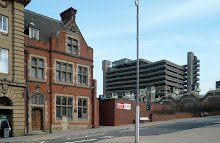
Workplace Gallery was founded by artists Paul Moss and Miles Thurlow. Based in Gateshead UK, Workplace Gallery represents a portfolio of emerging and established artists through the gallery programme, curatorial projects and international art fairs. Workplace Gallery opened in 2005 at 34 Ellison Street, Gateshead - part of Trinity Square Shopping Centre particularly noted for its iconic Brutalist car park designed by architect Rodney Gordon for the Owen Luder Partnership, which featured as a key location in Mike Hodges 1971 cult British gangster film Get Carter starring Michael Caine. Since the original gallery was demolished in 2008 Workplace Gallery has relocated to The Old Post Office in Gateshead, a listed 19th Century red brick building built upon the site where the important British artist, engraver, and naturalist Thomas Bewick (1753-1828) lived and died.

The next exhibition at Workplace Gallery will be a solo exhibition of new work by Cath Campbell opening on 18th February 2011. To celebrate the opening of Good Mourning Bell please join us afterwards at Central Bar in Gateshead.

Kindly supported by


Thursday, December 23, 2010

Seasons Greetings from all at Workplace Gallery


Laura Lancaster
Untitled, 2010
Oil on board
110 x 160 cm, 43 1/4 x 63 in
(LL0391)
Courtesy of the artist and Workplace Gallery
   

Friday, December 03, 2010

Catherine Bertola: "Beyond Pattern" DLI Art Gallery, Durham, UK


Catherine Bertola
Beyond Pattern
DLI Art Gallery, Durham, UK
04 December 2010 - 16 January 2011
http://county.durham.gov.uk
http://www.orieldavies.org/en/exhibition/beyond-pattern

Artists: Catherine Bertola, Michael Brennand-Wood, Nisha Duggal, Leo Fitzmaurice, Doug Jones, Adam King, Steve Messam, Henna Nadeem, Angharad Pearce-Jones, Pamela So, Andrea Stokes.

An exploration into the cultural meanings of 'pattern', through exhibition, commission, publication and debate, with work that utilises 'pattern' as a social, cultural and political commentator. With new commissions by Steve Messam, Catherine Bertola and Angharad Pearce-Jones and work by Michael Brennand-Wood, Nisha Duggal, Leo Fitzmaurice, Doug Jones, Adam King, Pamela So, Henna Nadeem and Andrea Stokes.
Pattern is all around us, whether we are conscious of it or not. It penetrates every aspect of our lives and can be found in the home, workplace, street, garden or in the landscape. Pattern's existence is not confined by our own manufacture as it forms the foundation for many aspects of the natural world. However, it is the manner in which we utilise pattern in our lives that forms the basis of this exhibition.
We often think of pattern simply as an adornment or perhaps even as a form of disguise, but it can also reflect a desire to communicate through a specific visual language. It might be that it represents cohesion and a sense of balance, thereby providing visual stimulation or a space for meditation. It can symbolise status or even be a device to convey ideas, express identity or specific ideologies, as well as presenting political beliefs or maintaining cultural traditions.
Work by eleven artists take us on a journey to explore these ideas and highlights how pattern can be, or has been, used as a social, cultural and political commentator that reaches beyond ornamentation and decoration. Whether these artists reference the domestic or public space, draw on contemporary or historical situations, comment on or observe aspects of society, subvert the familiar and question perception, they present a diverse reflection on the subject of pattern.
Beyond Pattern represents both conceptual and craft focused practices whilst reflecting an array of media; from metalwork to embroidered textiles and temporary public installation to hand cut collages. Individual works have been carefully selected to create intriguing, profound and sometimes surprising departure points for conversation.

Oriel Davies is delighted to commission work by Catherine Bertola and Angharad Pearce-Jones for the exhibition and also to commission the temporary site-based work titled Clad by Steve Messam.

A full colour publication accompanies this project with essays by Laura Mansfield and Lesley Millar. An Oriel Davies Touring exhibition curated by Alex Boyd. This project has been made possible through an Arts Council of Wales Beacon Company Award 2008-10. Supported by the National Lottery through Arts Council England and The Laura Ashley Foundation.

Image:
Catherine Bertola
Installation view of
From the palace at Hillstreet, 2009 and Bluestockings (Fanny Burney), (Hester Chapone), (Elizabeth Carter) and (Elizabeth Vesey), 2009
"Beyond Pattern" Oriel Davies Gallery, Newtown, Wales.
Courtesy of the artist and Workplace Gallery, UK.
   

Laura Lancaster: "Fade Away" Transition Gallery, London, UK


Laura Lancaster
Transition Gallery, London, UK
03 - 24 December 2010
http://www.transitiongallery.co.uk

Henny Acloque, Phillip Allen, Tim Bailey, Nathan Barlex, Mike Bartlett, Alice Browne, Lindsey Bull, Nick Carrick, Clem Crosby, Theo Cuff, Kaye Donachie, Sarah Douglas, Sarah Dwyer, Andrew Graves, Paul Housley, Thomas Hylander, Hannah Knox, Laura Lancaster, Robert Lang, Sarah Lederman, Eleanor Moreton, Mali Morris, Alex Gene Morrison, Nadia Mulder, Jill Mulleady, Mahali O'Hare, Scott O'Rourke, Joanna Pawlowska, Joanna Phelps, Benjamin Senior, Shaan Syed, Zack Thorne,Gavin Toye, Helen Turner, Claire Undy, David Webb, Robert Welch, Andy Wicks, Jo Wilmot.

Fade Away is the first in an ongoing series of exhibitions at Transition with different guest curators focusing on the diversity of contemporary painting and exploring the ways in which artists are engaged with it.
Fade Away, which is curated by Alli Sharma, with an accompanying text by Barry Schwabsky, features paintings that oscillate between representation and abstraction. With widely diverse references and subject matter, they all share a strong material presence. Whatever the creative enquiry, they make you think about paint and the act of painting.
Some of the Fade Away artists work directly from the perceptible world; others use the representational as a point of departure into the abstract, or conversely, explore the abstract, which reveals itself as subject.
The dialogue between surface and illusion, representation and abstraction performs a paradoxical balancing act where surfaces are brushed, scored, erased, layered, revealed, dripped and collapsed. Compositions teeter on the verge of illegibility where images emerge and fade away.

Image:
Laura Lancaster
Untitled, 2010
Oil on canvas
30.5 x 25 cm
(LL0270)